AI code review vs AI security review: why your code reviewer isn't catching vulnerabilities

Summary
A lot of teams we talk to think they already have AI security review, because they turned on GitHub Copilot code review, CodeRabbit or Claude Code Review. Those tools are good at what they're for: making pull requests better. They catch logic slips, tidy things up and flag the odd obvious security issue.
An AI security review does a narrower and harder job. It finds the vulnerabilities that are actually exploitable in your codebase, with little enough noise that developers fix them. Most teams shipping AI-written code need both, and the expensive mistake is assuming the first one covers the second.
Two different jobs
How to tell your code reviewer isn't covering security
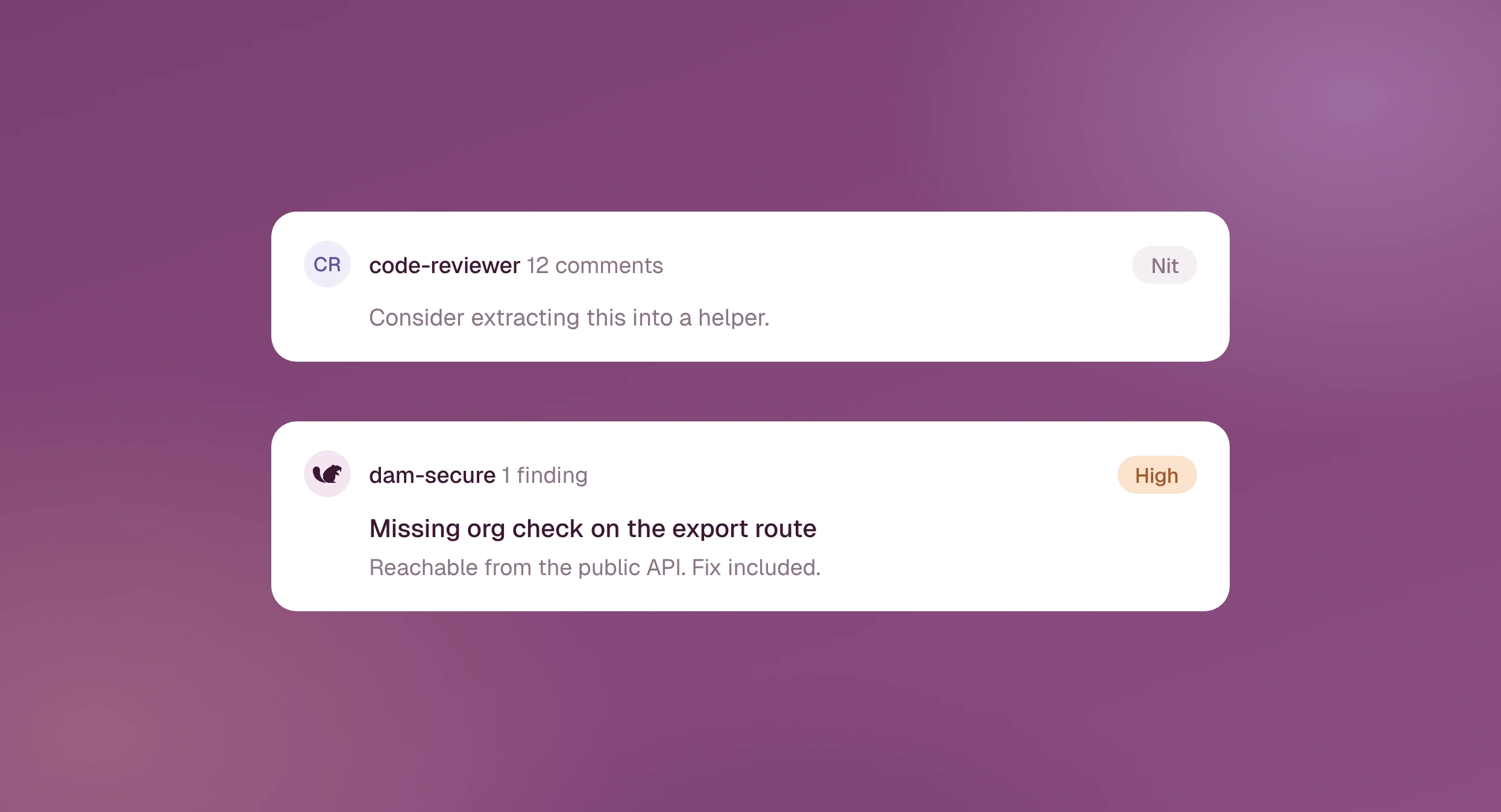
The easiest tell is volume. If a one-line change gets a dozen comments, developers learn to skim them, and the one security finding gets skimmed with everything else.
The next is context. Ask your reviewer whether a new endpoint checks the caller owns the record. If all it can tell you is that the caller is signed in, it'll miss every IDOR an agent writes.
Then there's memory and follow-through. Your team explains a false positive and the next PR flags it again. Or AppSec asks what's still outstanding and the honest answer is "it's somewhere in the PR threads". And severity is a coin toss, so a SQL injection behind an admin-only, audit-logged route gets the same red label as one on a public endpoint.
Why security needs its own review
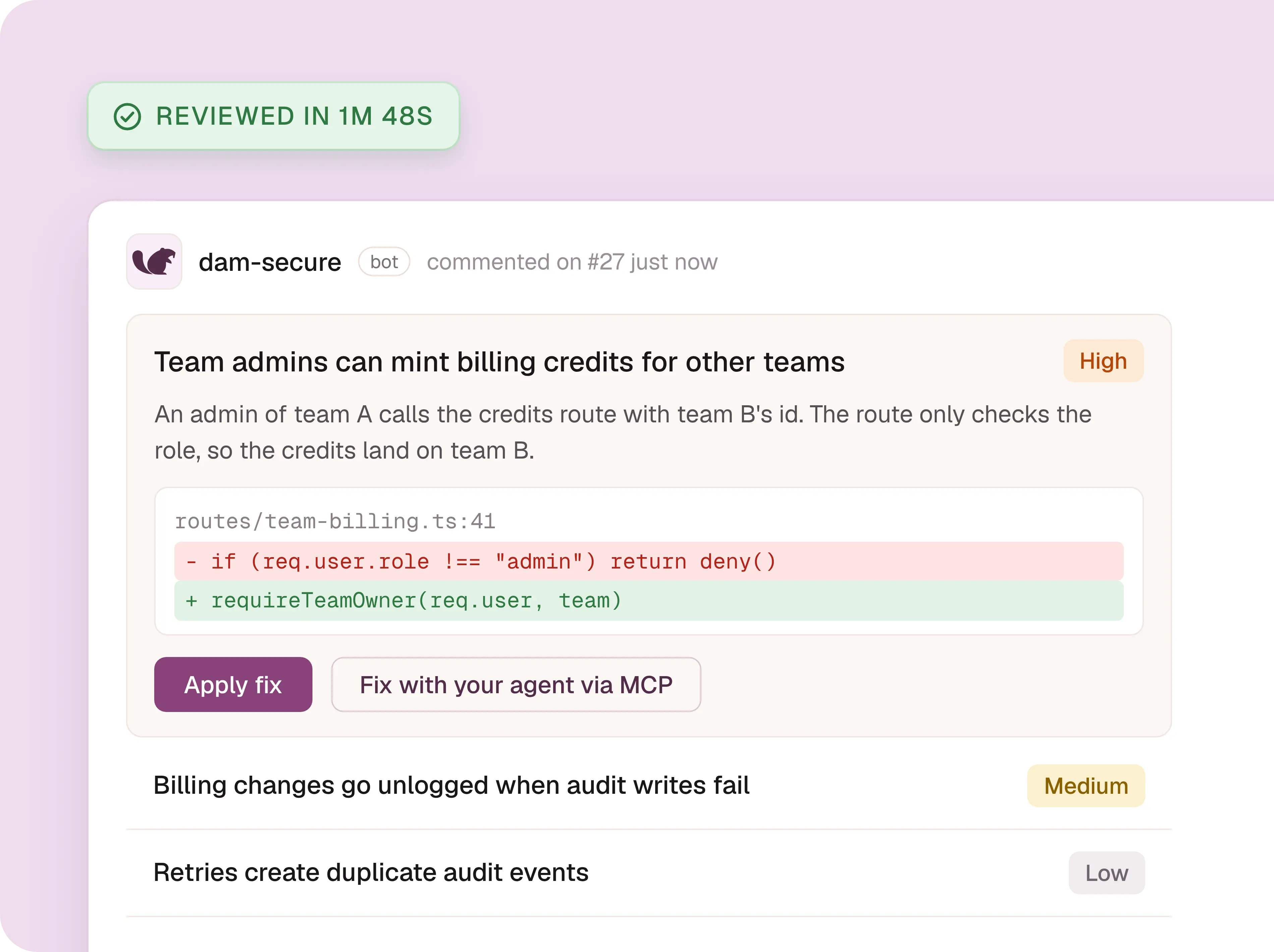
The flaws agents introduce most often don't look like flaws. An agent writes an endpoint that checks you're signed in but not that you're on the right team. It compiles, the tests pass, and a code reviewer has nothing to object to. Catching it takes a review that knows every other route in that service checks team ownership.
The volume makes it worse. Agents opened more than 40% of GitHub pull requests in September, up from 17% in March. Rationing security review to the PRs that look risky stopped working when most of the code stopped being written by people.
Review capacity hasn't kept up either. A Harvard working paper covering 718 companies and 49 million pull requests found that after teams adopted coding agents, PRs went up 23% while the time from opening a PR to merging it went up 49%, and the amount of finished work shipped didn't change in any measurable way.
At one mid-sized B2B company, Carnegie Mellon and Stanford researchers watched PR volume grow 3.1x while the reviewer pool grew 1.5x. The share of PRs that got a substantive human review fell from about 39% to 21%.
Running both without doubling the noise
Give each tool one job. Let the code reviewer handle quality and the security review handle exploitability, and turn off overlapping security checks in the code reviewer if they duplicate findings. Hold the security review to a low-noise bar: a handful of findings per PR, each with a reason it's exploitable and the fix.
Block merges only on high and critical security findings so everything else keeps moving. And keep both under a few minutes, because nobody acts on a review that comes back after they've moved on.
How Dam Secure fits

Dam Secure PR Security Reviews do the security half. At onboarding, Dam Secure maps how your codebase fits together, then reviews every pull request against that map in under two minutes. AI triage checks each finding for reachability and existing mitigations, so developers see fewer than five findings per PR instead of 15 or more, each with the fix included.
Findings become tracked issues that sync to Linear and Slack and close automatically when the fix lands, even across stacked PRs. Every fix, dismissal and PR comment feeds back in, so a false positive your team explains once stays gone. And because we route each review to the frontier model that's best at each vulnerability type, it costs a fifth of what a DIY setup does.
"Security PR reviews are critical for a scaling unicorn like Serval. General AI coding tools lack deep security codebase context and can't learn from their mistakes. Dam Secure does all of that out of the box." Sam "Frenchie" Stewart, Head of Security, Serval
FAQ
Do AI code review tools find security vulnerabilities?
Some, mostly the obvious ones. They aren't built to judge whether a flaw is exploitable in your codebase, so they tend to miss access control flaws and over-flag everything else.
Do I need a separate security review if I use Copilot code review or CodeRabbit?
If agents write a meaningful share of your code, yes. One makes the change better. The other makes sure it can't be exploited.
Can one tool do both?
It can try, but the two jobs pull in different directions. Code review rewards thoroughness. Security review rewards precision, because every false positive teaches developers to ignore the next real one.
Want a security review on every PR, alongside the code reviewer you already use? Speak to our team.