What does an AI PR security review really cost? The token math, explained.

Summary
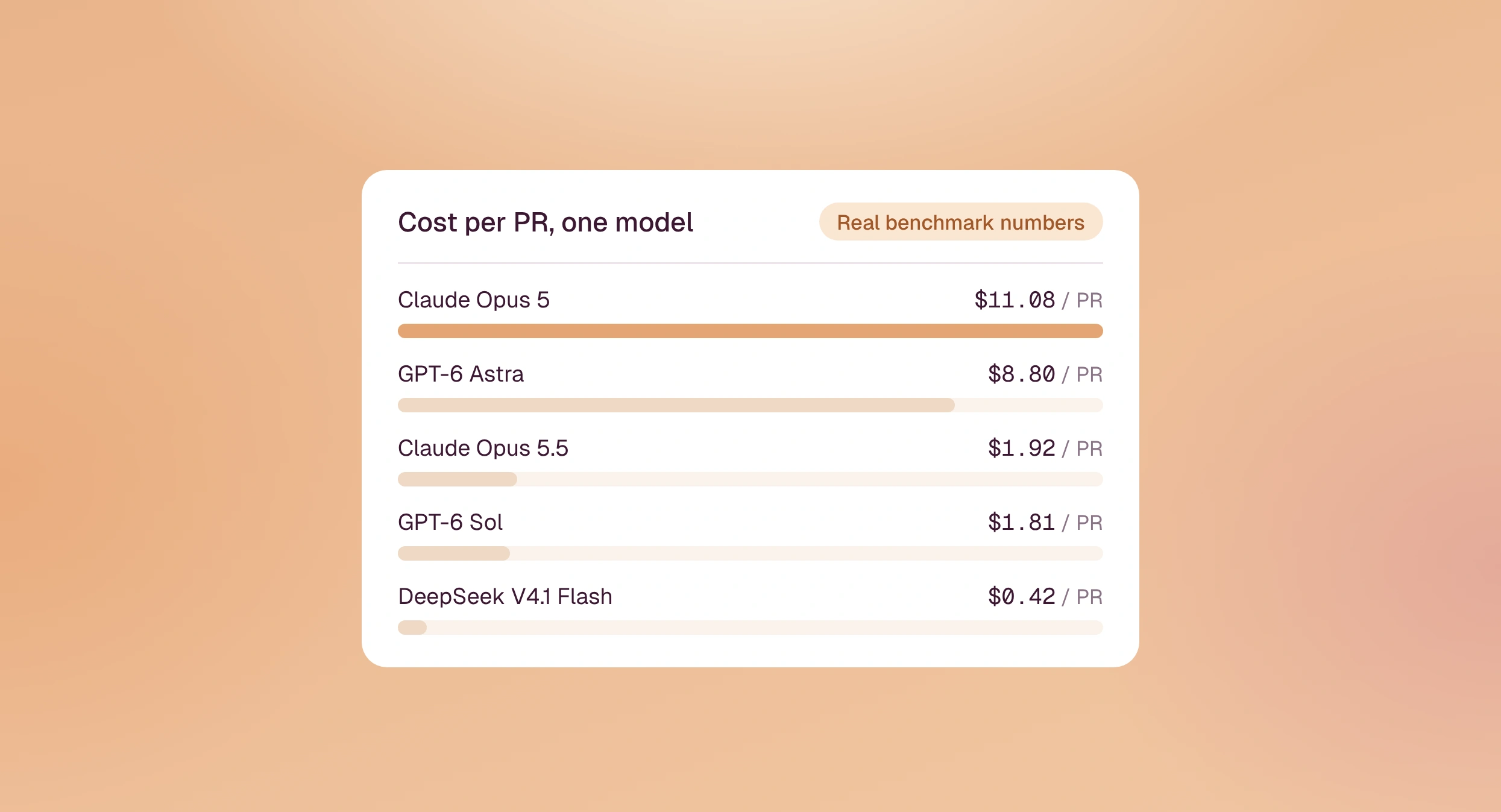
Everyone building or buying AI security review eventually asks the same question: what's this going to cost per pull request? The honest answer is "it depends on the model", and it depends a lot. In our September 2026 benchmark, among the models that found more than half the planted vulnerabilities, one review cost anywhere from $0.42 to $11.08, and the most expensive model didn't find the most vulnerabilities.
At 1,000 PRs a month, that's the difference between about $5,000 a year and about $133,000 a year, before anyone has written a line of code for evals, triage or memory. This post walks through the math, and the costs that don't show up on the token bill.
Cost per PR, by model
We planted 16 real vulnerabilities in 16 pull requests, then had 16 models review each PR five times. Here are the models worth talking about:
The full results, including the models that flopped, are in the benchmark post.
What that looks like over a year
Volume is the multiplier, and it's climbing. Merged pull requests on GitHub more than doubled in a year to 1.3 billion. At one mid-sized B2B company, Carnegie Mellon and Stanford researchers watched PR volume grow 3.1x after the company pushed engineers to use AI.
Take a team opening 1,000 pull requests a month, which is not a big number once agents are involved. Over 12,000 PRs a year, a single model reviewing each one costs:
And that's the floor for a DIY setup. Most teams don't stop at one prompt. They add a severity step, then reachability, then business context, and each step is another model call on every PR. As put in The Ceiling for DIY Security Reviews, by the third sub-agent finance starts asking questions.
The cheapest model isn't the cheapest review
Looking at that table, the obvious move is DeepSeek V4.1 Flash. It found as many planted vulnerabilities as Claude Opus 5 for about 4% of the price. The catch is the last column. It raised 8.8 findings for every real vulnerability, against 4.9 for Claude Opus 5.5. Developers had to wade through a lot of noise to find the real issue, and developer time isn't free. Neither is the trust you lose when a security tool flags everything.
There are other costs that never show up on the token bill. Someone has to build and maintain the harness, write evals for every step, and re-check calibration every time a model updates. Someone has to give the system memory, so dismissed findings don't come back on the next PR.
And someone has to keep an audit trail AppSec can actually show an auditor. That work is measured in engineer-months, on top of the dollars per PR.
Noise also costs review time, which is already the scarce thing. A Harvard working paper covering 718 companies and 49 million pull requests found that after teams adopted coding agents, review comments per PR went up 35% and the time to merge a PR went up 49%.
What actually brings the cost down
 Dam Secure security review
No single model wins on findings, speed, noise and cost at once. That's the main thing we've learned from running this benchmark over and over. Grok 4.7 found the most but took 18 minutes a PR. Claude Opus 5.5 was the fastest and quietest but found fewer. And one SSRF bug wasn't found by any of the 16 models in 80 attempts.
Different models are better at different vulnerability types, so the way to get frontier-model results without frontier-model prices is to route each part of a review to the model that's best at it, then verify findings before anyone sees them.
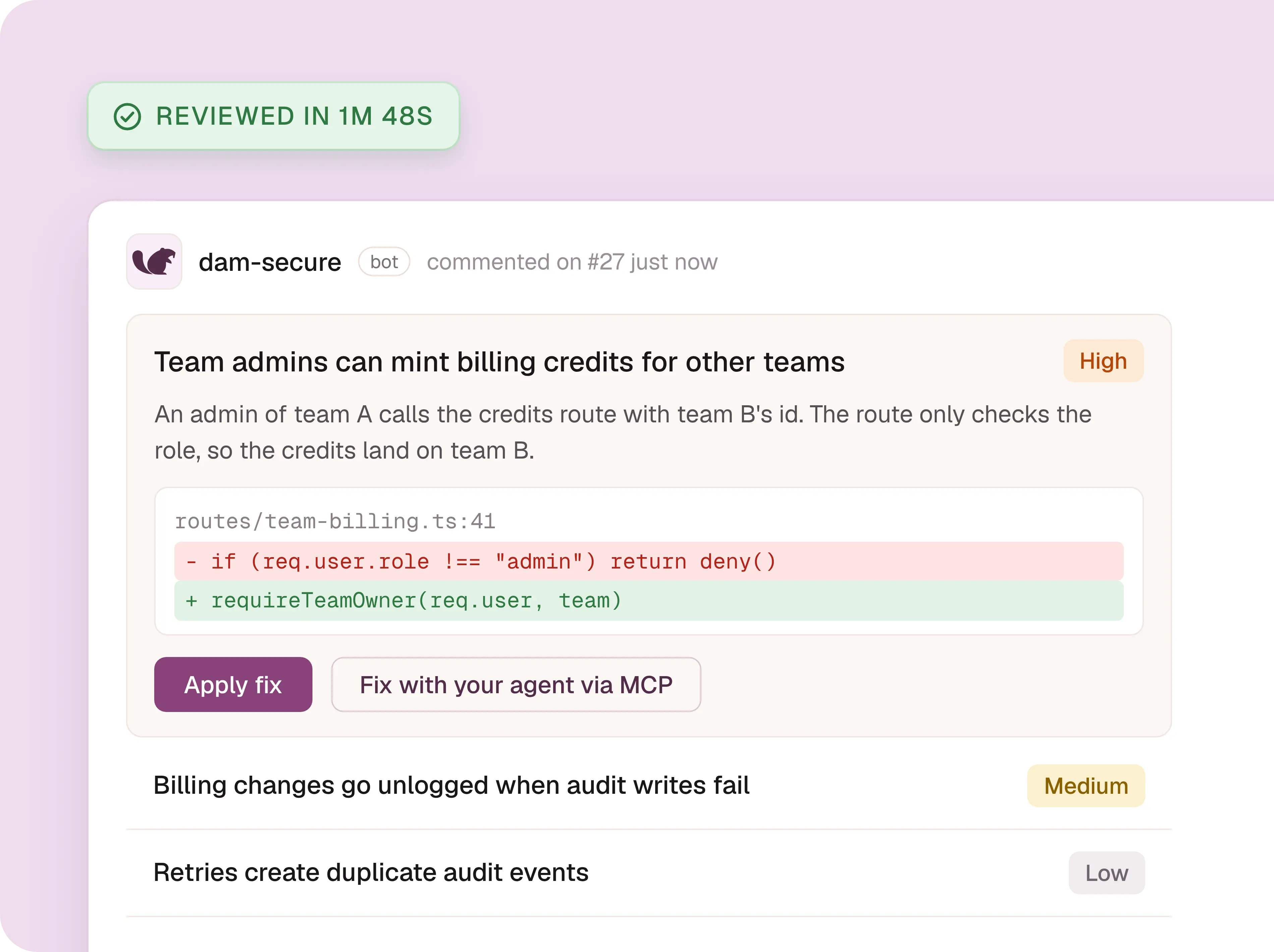
That's what Dam Secure does. We benchmark frontier models on real security findings, route every PR review to the models that perform best for its language and vulnerability types, and triage each finding for reachability before it reaches the PR. Reviews come back in under two minutes with fewer than five findings per PR, at a fifth of the cost of a DIY setup.
Findings become tracked issues with an audit trail, and every fix and dismissal feeds back in.
"Shortly after set-up, Dam Secure found a critical finding in a long-standing feature. It paid for itself very quickly." Doug Rathbone, VP of Engineering, Dovetail
FAQ
How much does an AI PR security review cost?
In our latest benchmark, a model that caught more than half the planted vulnerabilities cost between $0.42 and $11.08. Anthropic says Claude Code Review averages $15-25 per review. Multi-step DIY setups cost more again.
Is building your own AI security review cheaper than buying one?
On tokens alone it can look that way. Once you count noise, evals, memory, maintenance and engineering time, it usually isn't. More in The Ceiling for DIY Security Reviews.
Which model is best for PR security review?
None of them on every dimension. The best results come from routing different vulnerability types to the models that find them best.
Want frontier-model PR reviews without the frontier-model token bill? Speak to our team.