Is there an AI vulnerability scanner for code?

Summary
Yes. AI vulnerability scanners use language models to read your code and work out what it does, instead of matching it against a list of known patterns.
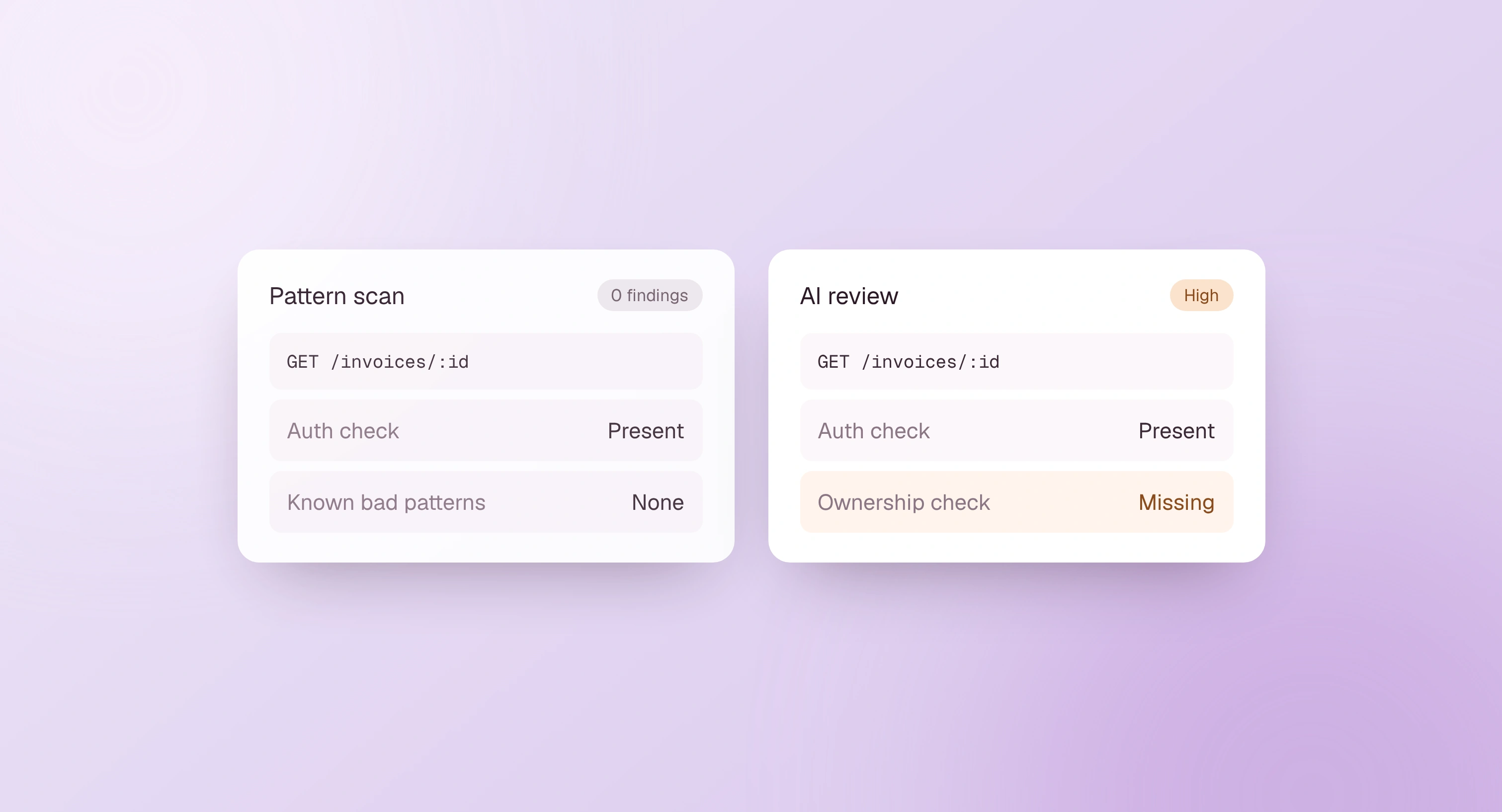
That lets them find flaws rule-based tools can't see, like an endpoint that checks you're logged in but never checks you own the record.
Dam Secure, Claude Security, Codex Security, Corgea and ZeroPath all scan code this way.
How does a traditional code scanner find vulnerabilities?
Most static analysis (SAST) tools work by matching code against rules.
A rule might say that user input flowing into a SQL string without a parameterized query is an injection risk, or that a string shaped like an AWS key is a hardcoded secret.
That works well for known, well-defined patterns. It's fast, and the same code gets the same result every time.
The limit is that a rule can only describe what code looks like. It can't describe what the code is supposed to do, so any flaw that depends on intent goes straight past it.
What does AI review find that pattern matching misses?
The gap shows up in four kinds of flaw. None of them have a fixed shape a rule can match.
1. Missing access checks
This is the classic case. An endpoint checks that the user is signed in, then loads a record by ID without checking that the record belongs to them.
Every line is valid code and nothing matches a known bad pattern, yet any signed-in user can read anyone else's data.
We cover this class in depth in our post on IDOR and business logic vulnerabilities.
2. Broken authentication logic
These bugs live in the order and meaning of checks, not in any one line.
In our PR security benchmark, the planted bugs included a stale session accepted after it should have been invalid, a cached authorization decision reused after permissions changed, and an identity check that proved the wrong thing.
A rule has nothing to anchor to in any of them.
3. Flaws that span several files
A validation step in one route doesn't protect a second route that skips it. A helper that's safe in one place gets called somewhere it isn't.
Finding these means following how the codebase fits together, which is exactly what a model can do and a single-file rule can't.
4. Whether a finding actually matters
The same code can be critical in one place and harmless in another.
A SQL injection behind a gateway that casts input to an integer first isn't exploitable. A command injection in a one-off seed script never runs in production.
Pattern matching flags both at full severity, which is a big part of why rule-based tools are so noisy. AI review can work out who could actually exploit a finding and what's already in the way before it reports anything.
How good are AI vulnerability scanners in practice?
It depends on how the scanner is built around the model. Three things make the biggest difference.
What context it has
A model reading one diff can only judge the lines in front of it. To tell whether a missing check matters, it needs to understand how your services, data flows and auth fit together.
Dam Secure builds a knowledge graph of your codebase, so every review starts with that context.
How it runs the review
Some scanners send everything to one model in a single pass. That's simple, but no single model is best at every type of vulnerability.
Dam Secure researches the code first, then routes each part of the review to the models that perform best for that language and vulnerability type, based on our ongoing benchmarks.
How it triages findings
Raw model output is noisy. In our benchmark, models raised between 4.9 and 14.4 findings for every real bug.
Dam Secure runs in-depth AI triage on every finding. It works out who could exploit it, what access they'd need, which controls already block the path and what they'd actually gain, then rates likelihood and impact from evidence in your code.
Severity can come down but never goes up, and a finding is only dismissed when the code shows it causes no real harm. Your team's dismissal notes carry into later runs. That's how reviews stay under five false positives per PR.
When you compare scanners, ask about all three. The model on its own tells you surprisingly little.
Do AI vulnerability scanners replace SAST?
For many teams, they can. AI-native scanners cover the known patterns rule-based SAST catches, plus the logic flaws it misses, and they cut noise by checking exploitability.
Rule-based tools still have a place where you need the exact same result every run, such as a compliance gate on a narrow set of rules.
If you're evaluating one, look at four things: how much noise it produces per real bug, whether it assesses real exploitability before reporting, whether it learns from your team's dismissals, and whether it's tied to a single model.
How Dam Secure fits
AI-Native SAST reviews your whole codebase with frontier models instead of pattern matching.
When you connect a repo, Dam Secure maps how your codebase fits together, including services, data flows and auth, then runs a baseline review of your default branch. You can run a new scan whenever you need one.
Fixes and dismissals carry across rescans, so the same finding doesn't keep coming back. Teams find 40% more exploitable vulnerabilities than with their previous scanner, with 3x less noise.
For the same review on every pull request, see PR security reviews.
Want to see what a scan finds in your codebase? Speak to our team.
FAQ
Is there an AI vulnerability scanner for code?
Yes. AI vulnerability scanners, often called AI SAST, use language models to read code and reason about what it does. Examples include Dam Secure, Claude Security, Codex Security, Corgea and ZeroPath.
Can AI detect vulnerabilities that traditional SAST misses?
Yes, especially flaws that depend on intent rather than syntax, such as missing access checks, broken authentication logic and issues that span several files. Rule-based tools can't match these because they have no fixed pattern.
Are AI vulnerability scanners accurate?
It depends on how the scanner is built: the context it has about your codebase, how it runs the review and how it triages findings. The model alone varies a lot. In our benchmark, recall ranged from 32.5% to 77.5% across 16 models on the same PRs.
Do AI code scanners produce false positives?
Yes, though the good ones produce fewer than rule-based tools because they assess who could exploit a flaw, which controls already block it and what an attacker would actually gain. In our benchmark, models raised between 4.9 and 14.4 findings for every real bug found.