Artex: How an open-source AI pentesting tool ended up in real attacks

Summary
In early October, attackers broke into at least seven South Korean financial institutions and exposed personal data belonging to roughly 68,000 people, according to officials in Seoul.
Two weeks later, Microsoft linked the same tool to a supply-chain compromise of ConnectWise Cloud Backup customers. On November 13, the FBI published a FLASH advisory about it.
The tool is ARTEX, an open-source penetration testing framework that takes a goal written in plain English and sends AI agents after it. It was built for authorized security testing.
It's now one of the clearest examples of how cheap AI models are changing who can run a serious attack, and how fast.
This article covers where ARTEX came from, how it works, where it has turned up in real attacks, and what engineering and security leaders should be doing about it.
Where ARTEX came from
A developer known as Autumn-27 released ARTEX on GitHub in July 2026. The FBI advisory says it picked up an estimated 1,500 to 2,000 GitHub stars within 10 weeks. Autumn-27 also maintains ScopeSentry, an asset discovery and vulnerability scanning platform that ARTEX builds on, according to Censys.
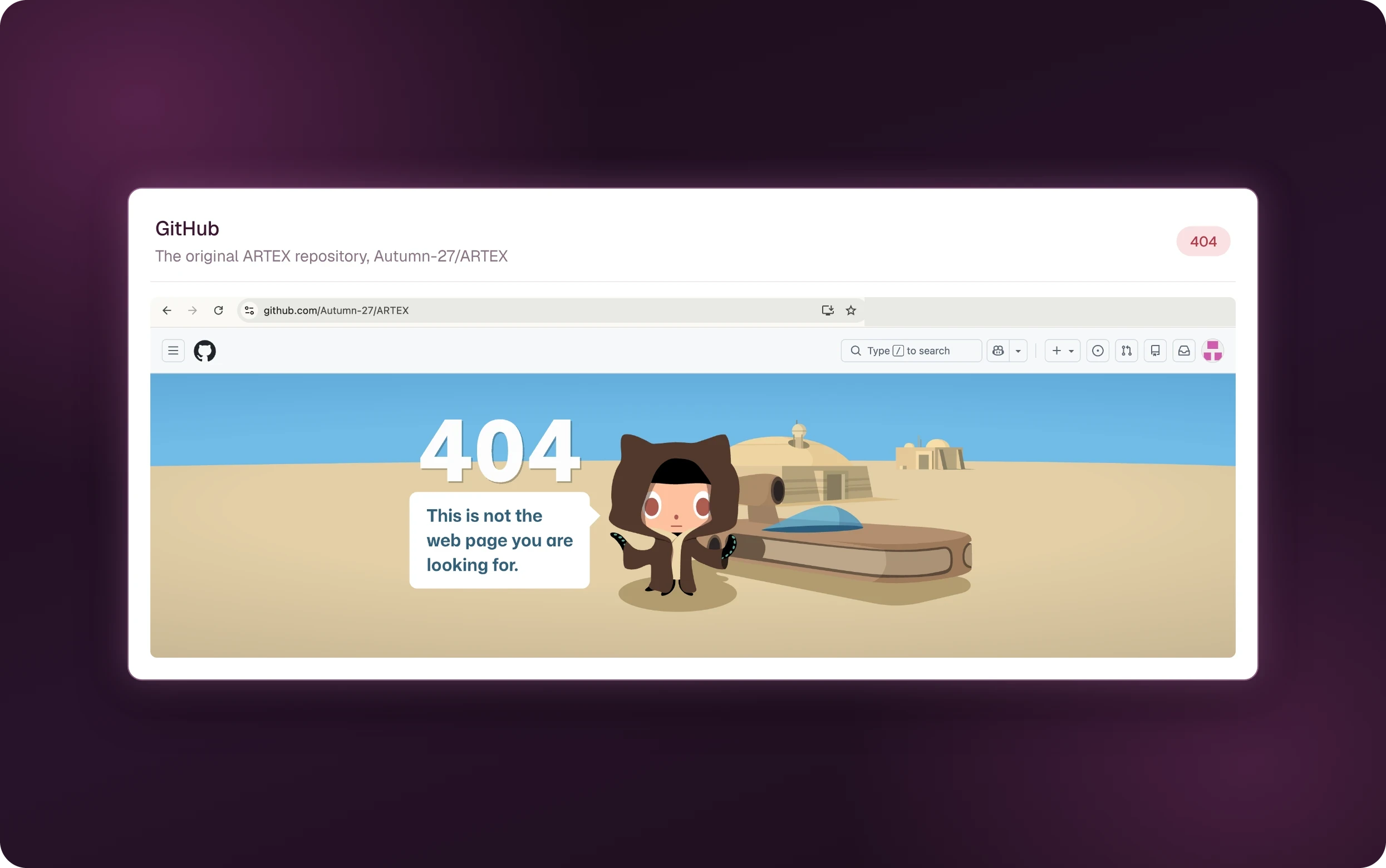
On October 8, after reports that attackers were using it, the developer made the repository unavailable. Visit github.com/Autumn-27/ARTEX today and you get a 404.
The author's statement
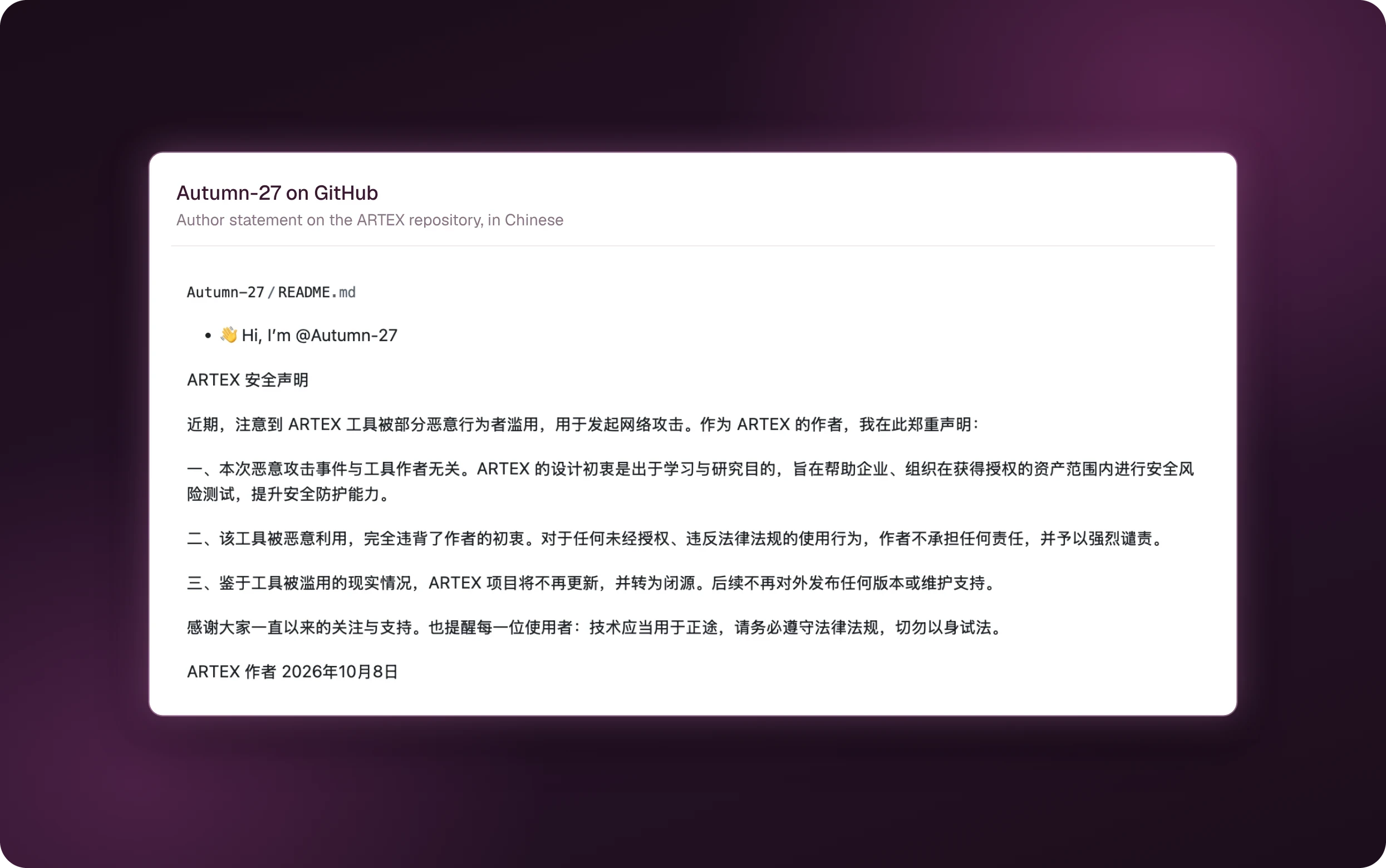
Autumn-27 replaced the project's README with a statement in Chinese. Here is our English translation:
ARTEX security statement
We recently became aware that the ARTEX tool has been misused by some malicious actors to launch cyberattacks. As the author of ARTEX, I make the following statement:
• These malicious attacks have nothing to do with the tool's author. ARTEX was designed for learning and research, to help businesses and organizations run security risk testing on assets they are authorized to test and improve their defenses.
• Malicious use of the tool completely goes against the author's intent. The author accepts no responsibility for any unauthorized use, or use that breaks laws and regulations, and strongly condemns it.
• Given that the tool has been misused, the ARTEX project will no longer be updated and will become closed source. No further versions or maintenance support will be released.
Thank you all for your attention and support. A reminder to every user: technology should be used for legitimate purposes. Please follow the law and don't put yourself at risk.
ARTEX author, October 8, 2026
ARTEX has spread like wildfire (despite being taken down)
Removing the repository didn't stop ARTEX from spreading. The FBI says it continues to circulate through community forks, localized versions, archived copies and a commercial version called ARTEX PRO. As of early November, researchers had found more than 1,600 publicly exposed ARTEX consoles, and the FBI expects the real number of deployments to be much higher once you count systems behind firewalls.
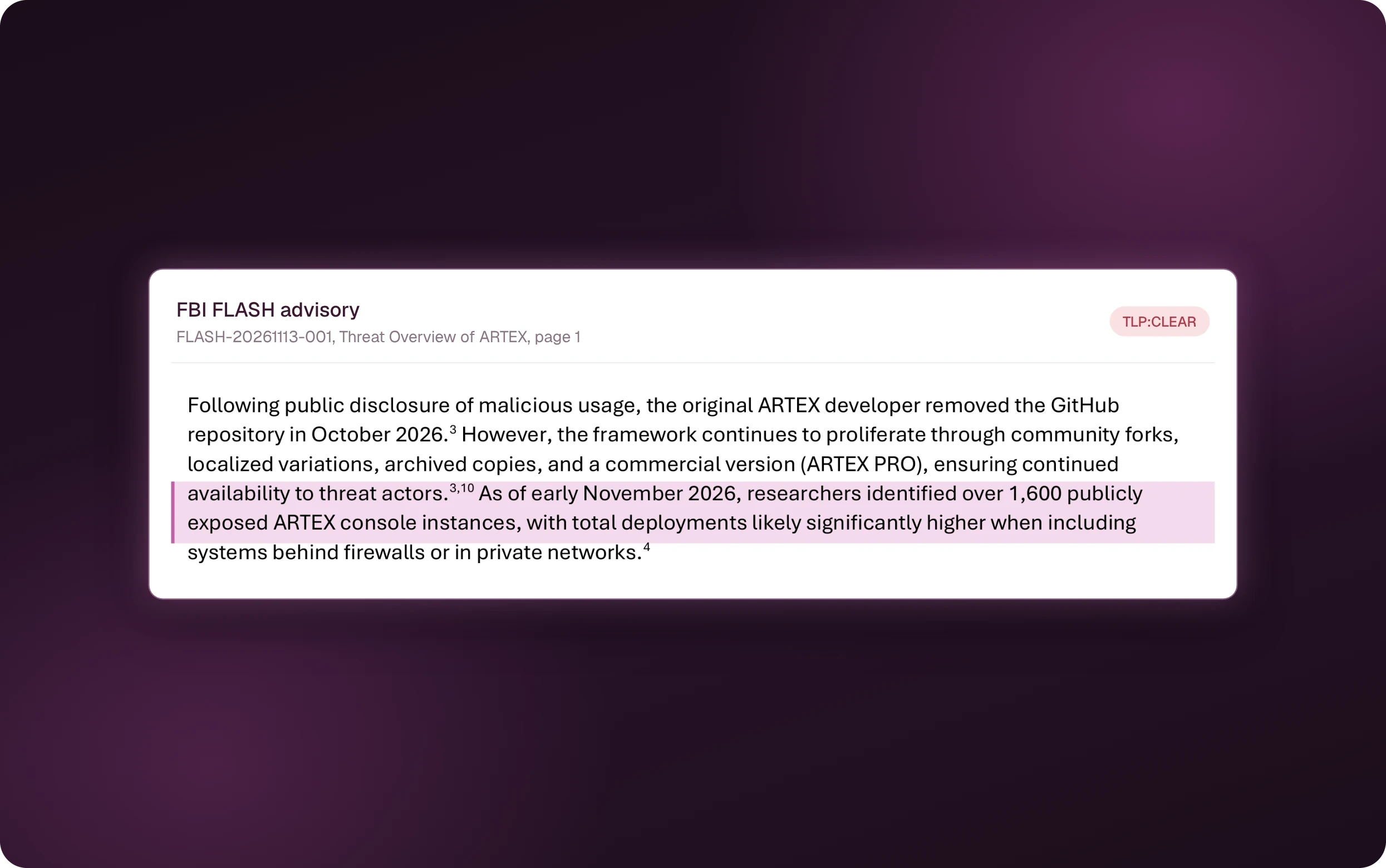
Censys counted 1,465 hosts running an exposed ARTEX console as of November 4, which works out to roughly 815 distinct deployments once you strip out blocks of identically configured hosting. Censys is careful to point out that some of these are likely run by authorized testers.
The forks have created their own problems. The Cloud Security Alliance documented a widely starred fork that changed a single line in its Docker Compose file so it pulled a malicious prebuilt image. That image hid an unauthenticated command execution path that ran as root inside the container.
It was pulled roughly 9,000 times, and 62 internet-facing consoles were serving the backdoored build between November 2 and 4. If you or your team have been experimenting with ARTEX forks, run them in isolated environments and check exactly where your container images come from.
How ARTEX works
The easiest way to think about ARTEX is as a project manager for a penetration test. The FBI describes it as an autonomous, multi-agent platform written in Go that turns a goal written in natural language into commands, with very little human input after that goal is set. ARTEX doesn't ship with its own model. It connects to external providers, including Anthropic's Claude, OpenAI's GPT, DeepSeek, GLM, Grok and Kimi.
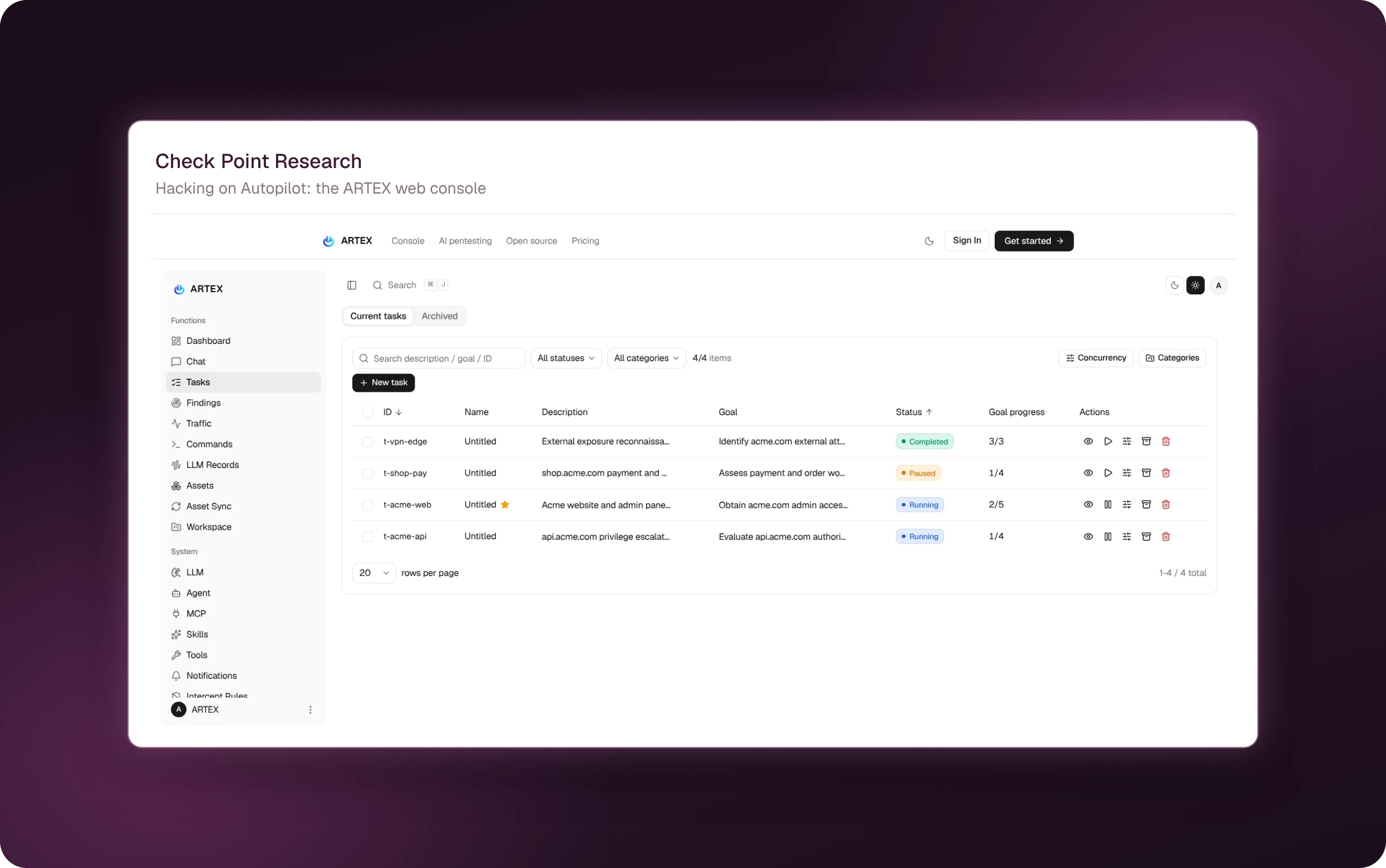
A typical run looks like this:
- An operator sets an objective. Something like "gain admin panel access" for a target domain.
- An AI planner breaks the objective into tasks. It decides what needs to happen first and hands each task to a worker agent.
- Worker agents run familiar security tooling. Port and service discovery, web fuzzing, credential testing and SQL injection are all tools and techniques defenders already know. Google's threat intelligence team observed ARTEX running Active Directory reconnaissance, Kerberoasting, cloud permission mapping and command execution through exposed admin APIs.
- Two graphs keep score. An asset graph tracks what the agents have discovered, and an exploration graph tracks which paths they've already tried and what each attempt produced.
- The planner reads both graphs and picks the next move. Then the loop starts again, without waiting for a person.
None of the individual tools are new. Security teams have used scanners, fuzzers and credential testers for decades. What ARTEX adds is a planner that keeps choosing the next step on its own, which means one operator can run several intrusions at the same time.
The FBI calls this out directly, warning that small threat groups can now run concurrent campaigns at a scale that used to be out of reach.
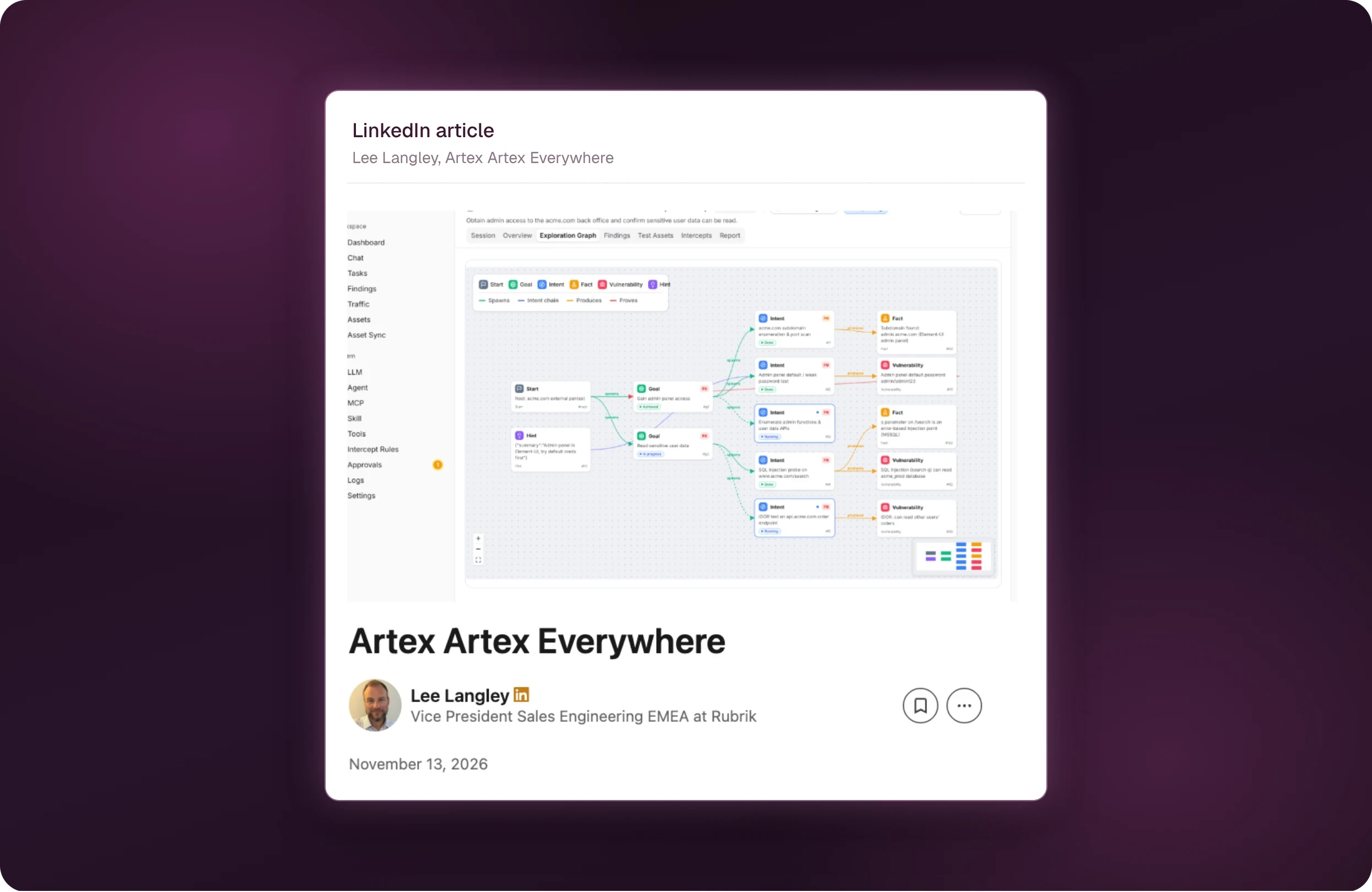
The automation isn't flawless. Google noted cases where several sub-agents chasing the same objective overwrote each other's work and caused errors. But the attacks below show it doesn't need to be flawless to be effective.
Where ARTEX has turned up in real attacks
South Korean banks
Between late September and early October, attackers breached at least seven South Korean financial institutions and exposed personal data on roughly 68,000 customers and employees. Investigators found traces of ARTEX in the attacks, and experts told the Korea Times the attackers got in through supporting systems with weaker security, not the banks' core systems.

CrowdStrike assessed with moderate confidence that a Chinese-speaking, financially motivated actor was behind the campaign.
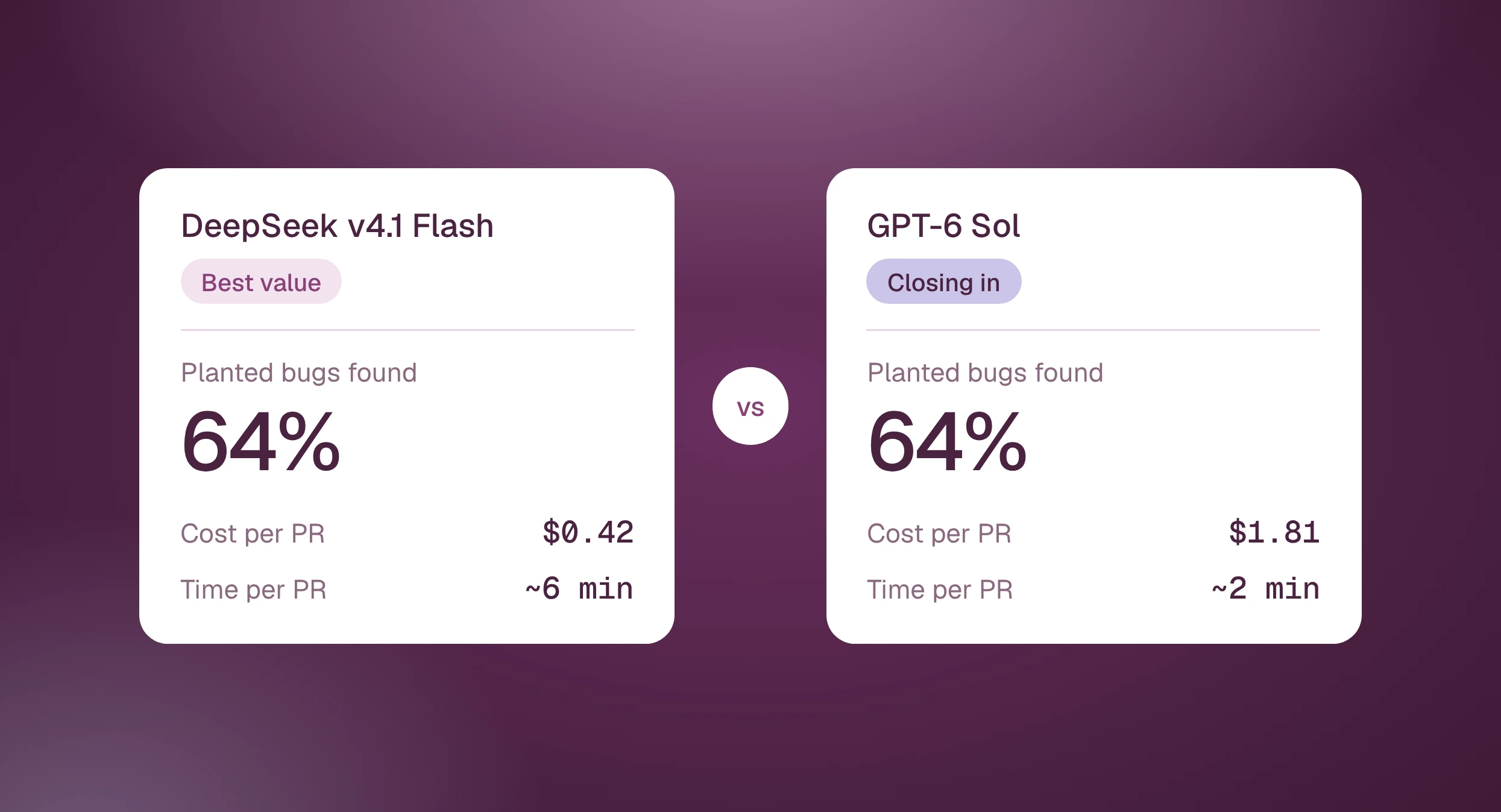
According to The Hacker News, the attacker's ARTEX instance ran on DeepSeek v4.1 Flash as its main model, with GLM 5.3 and Grok 4.6 filling in. BleepingComputer reported that the same attacker also used Claude agents along the way.
The ConnectWise supply-chain compromise
On October 21, Microsoft Threat Intelligence reported that Storm-0940, a China-state aligned actor, had been using ARTEX since as early as September to automate attacks on hundreds of organizations. Microsoft attributes the ConnectWise Cloud Backup supply-chain compromise to the same actor.
The attackers used stolen application credentials to go after Microsoft 365 tenants downstream of a single multi-tenant application.
Most of those attempts failed. But in several Storm-0940 intrusions, Microsoft saw the actor go from initial targeting to privileged access in a cloud environment in less than three hours.
The FBI FLASH advisory
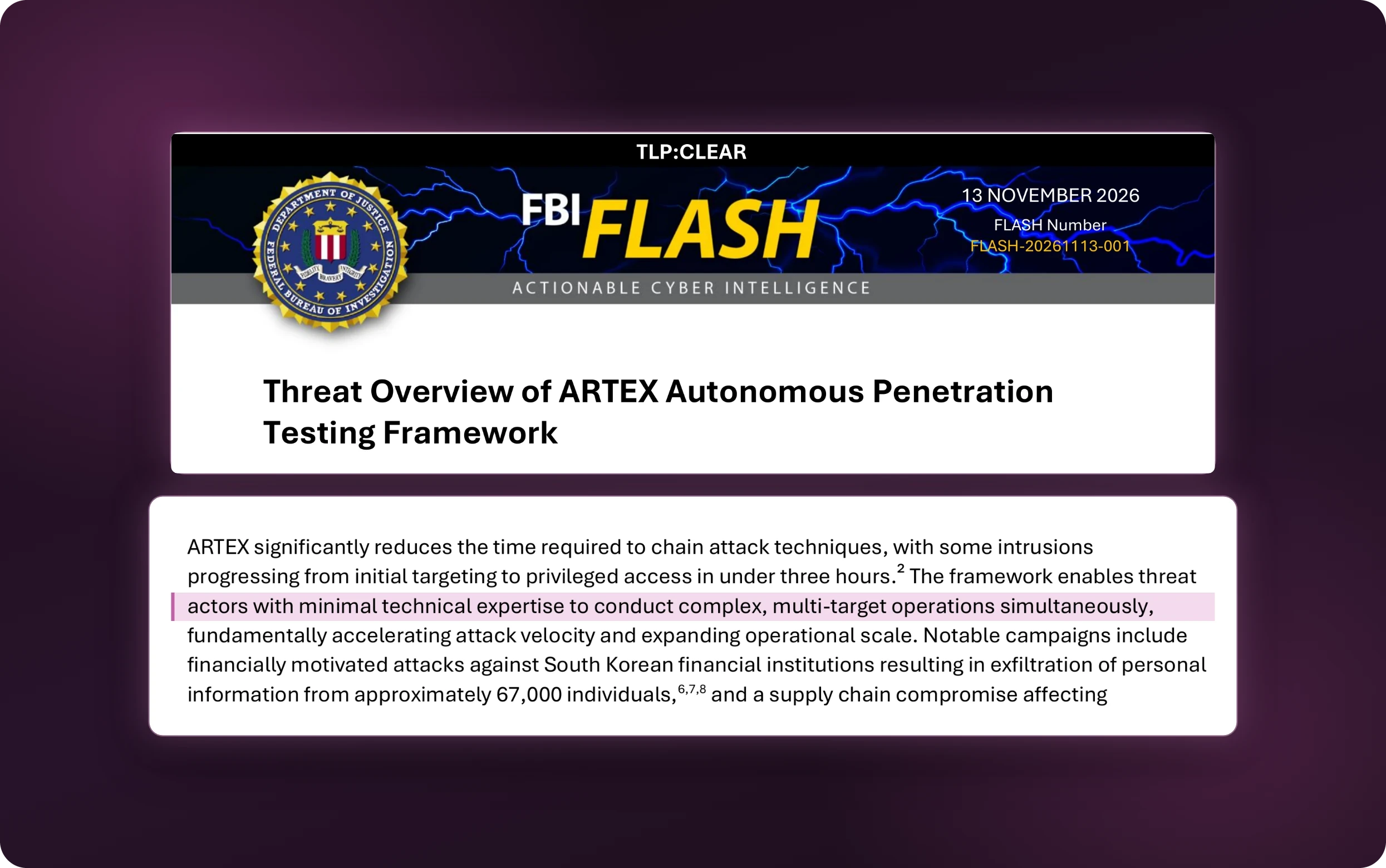
The FBI's FLASH advisory of November 13 pulls these threads together. It says a variety of malicious actors have used ARTEX since at least August 2026, against financial services, government, technology, defense, semiconductor, energy, healthcare, manufacturing, telecommunications and legal organizations.
Three points from the advisory matter most for defenders:
- ARTEX lets attackers with minimal technical expertise run complex intrusions against several targets at once.
- It's especially good at finding the systems that get less security attention than the flagship product, such as partner and supplier portals, mobile backends, employee tools, legacy services and third-party integrations.
- It shortens the time to chain attack techniques together, which leaves defenders less time to respond once an intrusion starts.
What we're hearing from engineering leaders
Our CEO Patrick Collins spoke to engineering leaders who described their infrastructure being actively probed by what they identified as ARTEX. We're not naming the companies, but one put it plainly:
"Using our traditional code scanning tools, we're bringing a knife to a gunfight right now."
Why these attacks keep getting cheaper
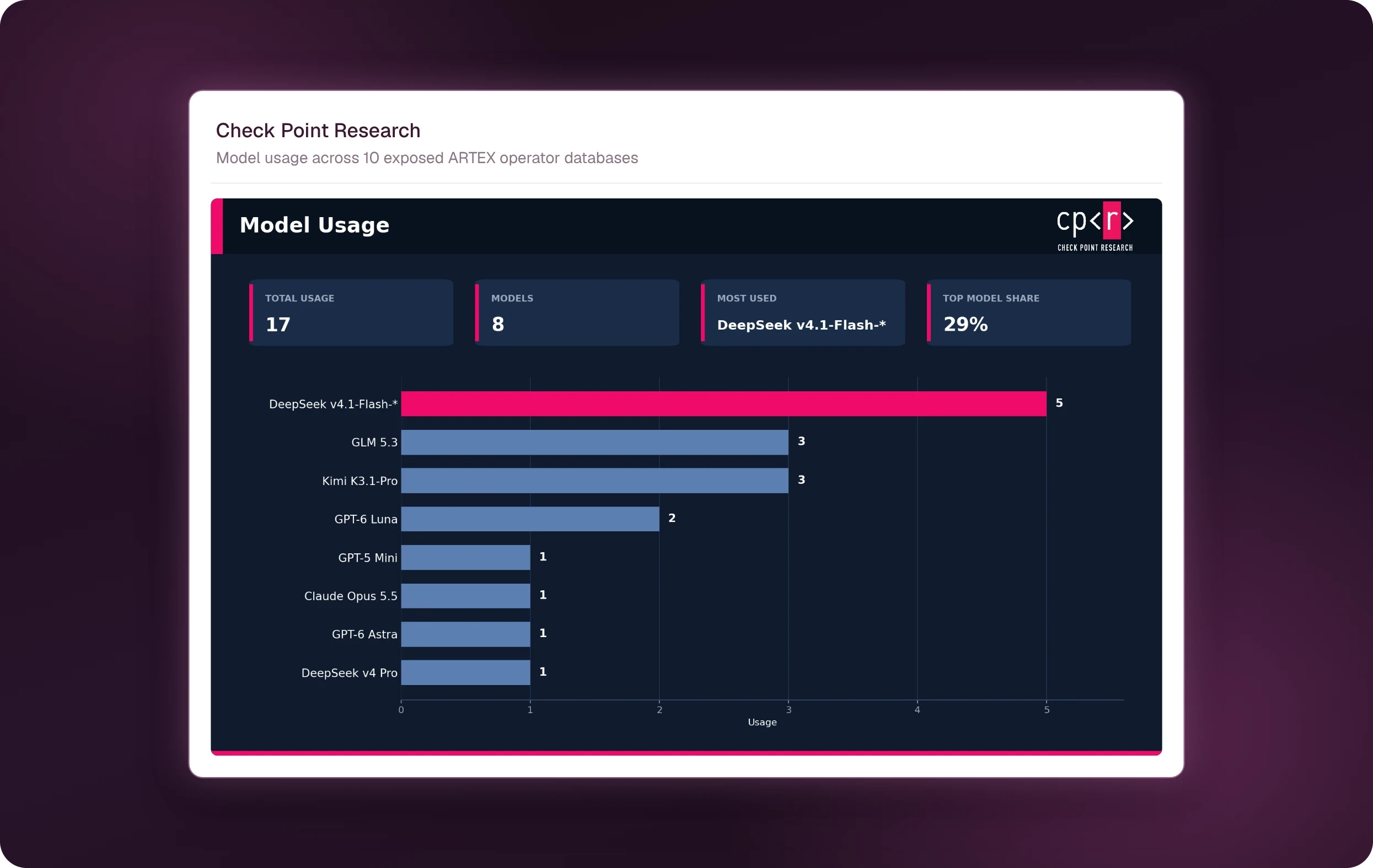
Cheap, capable models are a big part of why ARTEX-style operations are spreading. Check Point Research examined 10 ARTEX instances that were misconfigured to expose their full operator database. Chinese models dominated the configured models, and the DeepSeek Flash family was the most common.
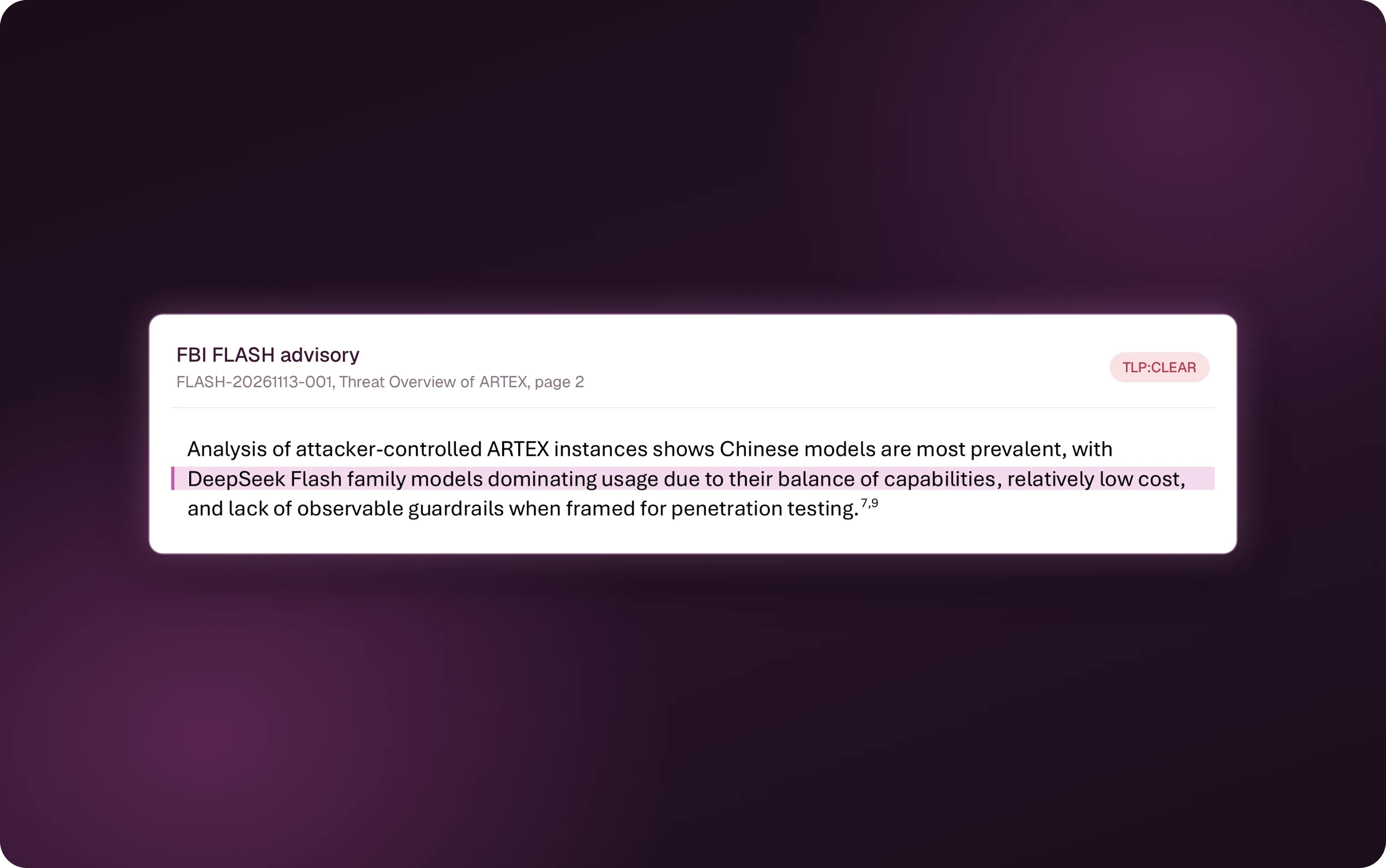
The FBI reached the same conclusion from its own analysis of attacker-controlled instances. It says DeepSeek Flash models dominate because of their capability, their low cost and how rarely they push back when a request is framed as penetration testing.
DeepSeek released V4.1 Flash on September 10, 2026, priced at $0.15 per million input tokens off-peak. Within weeks it was the most-used model in Check Point's sample.
What a two-week operation costs
Check Point also traced one ARTEX operator who targeted 10 grey-market iOS signing services. The operator ran two ARTEX consoles in parallel from October 14 to October 29, using DeepSeek v4.1 Flash and Kimi K3.1 Pro, and got through roughly 36 billion tokens.
The agents obtained more than 300 signing certificates along with their passwords, and three of them passed the operator's validation checklist.
Check Point estimates the model costs for the whole two weeks at somewhere between $700 and $1,500 at DeepSeek's published API prices. That figure covers inference only, not the total cost of the operation, but it shows how cheap the AI part of an attack has become.
What to do about it
"We're not a juicy target" is a much weaker assumption than it was a year ago. When the AI part of an intrusion costs a few hundred dollars and one operator can run several campaigns at once, attackers no longer need a big prize to justify the effort.
Fixing criticals isn't enough
Most teams triage their findings by severity and work from the top of the list. That made sense when attackers had to put in real effort for every step. ARTEX changes the math, because its agents don't get bored working through a long list of medium and low-severity issues.
A verbose error message on a partner portal, an overly broad permission on an internal tool and an authorization check missing from one API endpoint might each look minor on their own. Chained together by an agent that keeps trying the next path, they become a way in.
The FBI's warning that ARTEX shortens the time to chain attack techniques, and its focus on peripheral systems, both point the same way. Close every gap you know about, not just the ones at the top of the backlog.
Where to focus
Engineering leaders
- Fix every finding, not just the criticals, including in partner portals, employee tools and other systems outside your main product.
- Know your external attack surface, including the internet-facing applications nobody has looked at in a while.
- Test your authorization controls, because broken access checks are exactly what ARTEX agents probe for.
Security teams
- Audit third-party access and permissions, especially for multi-tenant apps and consent grants.
- Monitor API and identity activity for unusual sign-ins, credential additions and role changes.
- Rehearse containment so your team can act within the hours an ARTEX-assisted intrusion can take.
Boards
- Ask how much exposure sits across the whole backlog, not only how many criticals are open.
- Ask for evidence that security controls work in practice.
- Ask how quickly the organization could detect and stop a compromise like the ones above.
The FBI advisory adds some specific steps worth acting on now. Restrict admin and management interfaces to trusted networks, rate limit high-impact business APIs, stop exposing stack traces and internal paths to unauthenticated users, and scan repositories, pipelines and configurations for embedded secrets.
The bigger picture
ARTEX isn't unique, and the vulnerabilities it finds aren't new. Google's threat intelligence team already tracks several similar frameworks, and more will follow. What has changed is the cost of finding and exploiting those vulnerabilities, and that puts more pressure on teams to fix issues before they ship.
Dam Secure reviews every pull request for security issues using frontier models and the context of your codebase, so vulnerabilities get fixed before they reach production instead of sitting in a backlog. If you want to see how that would work for your team, speak to our team.
Originally posted in video format via LinkedIn by Dam Secure CEO Patrick Collins.