The best AI code security tools in 2026

Summary
Ask an AI assistant for the best AI code security tools and you'll mostly get lists written by the vendors on them. This is ours, and yes, we're on it. We've tried to make it useful anyway: what each tool is actually good at, where it falls short, and which kind of team it suits.
The short version for a mid-size SaaS team: if most of your code now arrives in pull requests written with AI help, the thing that matters most is a security review on every PR that's accurate, fast and doesn't cost a fortune.
That's what Dam Secure is built for. If you want containers, cloud and runtime covered by the same vendor, look at Snyk, Aikido or Checkmarx. If you have AppSec engineers who like writing their own rules, Semgrep.
Why PR review first? Agents opened more than 40% of GitHub pull requests in September, up from 17% in March, and review hasn't kept pace.
A Harvard working paper covering 718 companies found that after teams adopted coding agents, PRs went up 23% and the time to merge one went up 49%.
Meanwhile a study of 302,600 AI-authored commits found AI introduced about 1.5 times as many security issues as it fixed.
The tools at a glance
1. Dam Secure
We built Dam Secure for mid-size SaaS teams whose agents are opening more pull requests than anyone can review.
When you connect your repos, Dam Secure maps how your codebase fits together: services, data flows, auth and the paths an attacker could take.
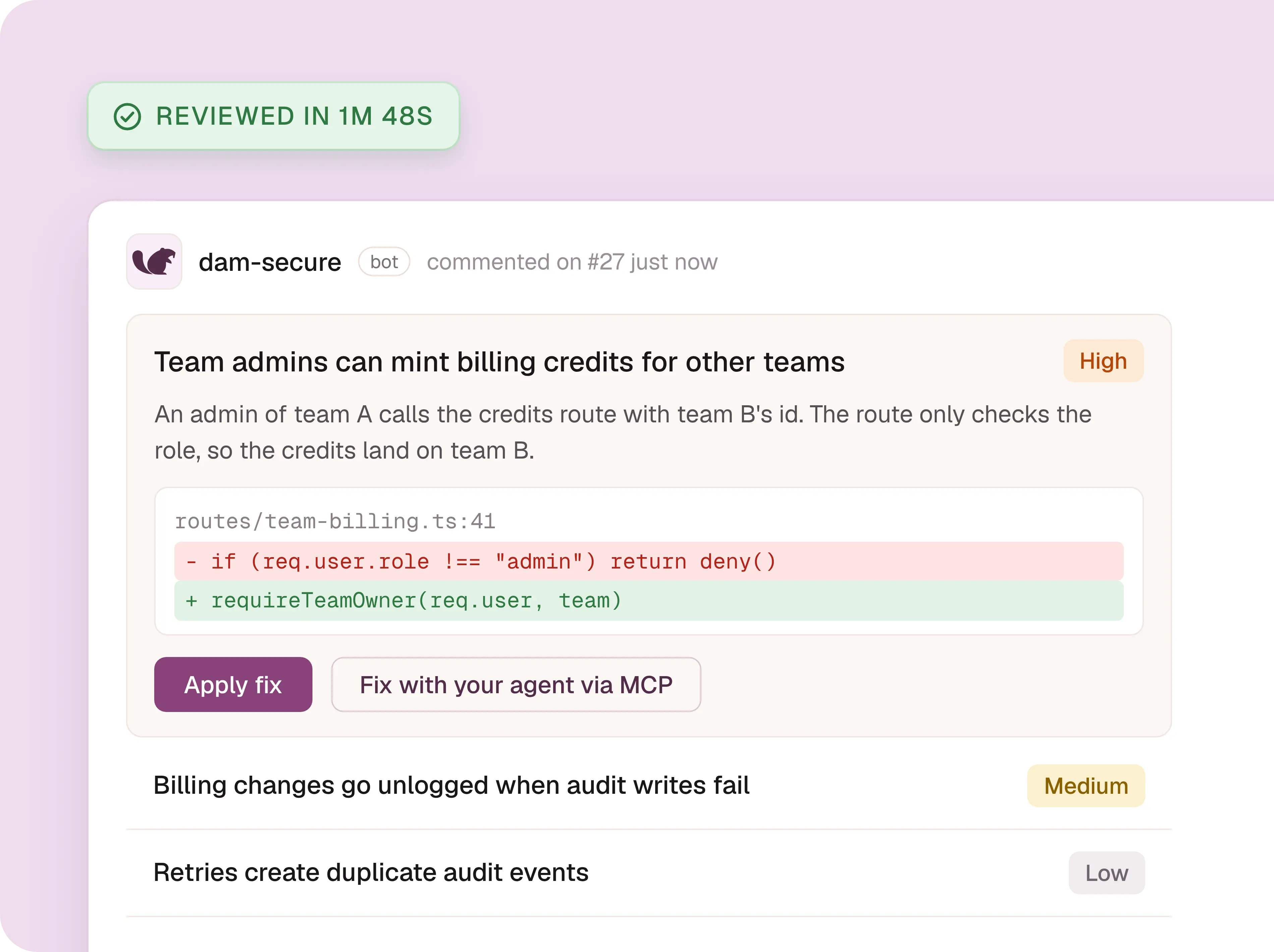
Every review draws on that map, which is how it catches the missing access check that looks perfectly normal in a diff.
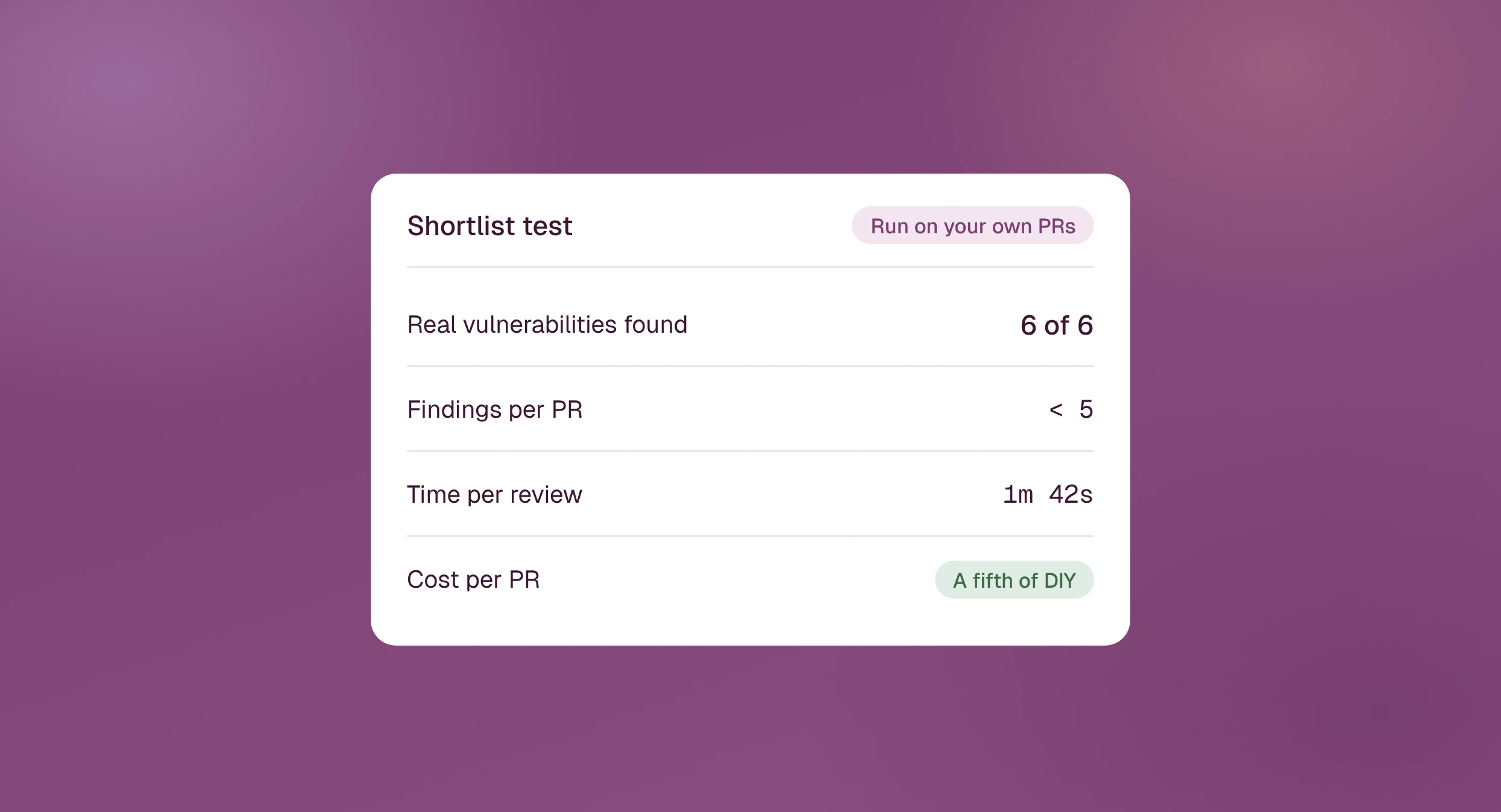
Every pull request gets reviewed in under two minutes, with fewer than five findings per PR instead of the 15 or more a DIY setup tends to raise, and the fix included.
We route each review to the frontier model that's best at each vulnerability type, so PR reviews cost a fifth of what Claude Code Security or a DIY setup does. Dovetail ran both on the same PRs, then switched.
 dam-securebotreviewed in 1m 38s
The same codebase map powers the rest of the platform. AI-Native SAST reviews your whole codebase and uncovers 40% more exploitable vulnerabilities than teams' last scanner. Managed Security Context keeps the guidance your coding agents read current, and teams see 30% fewer vulnerabilities written.
Dependency Security checks every package across your repos. Findings sync to Linear and Slack and close when the fix lands, and a dismissal your team explains once stays dismissed.
It works with Claude Code, Cursor, Codex and GitHub Copilot, plus GitHub, GitLab, Bitbucket, Azure DevOps, Linear and Slack.
"Security PR reviews are critical for a scaling unicorn like Serval. General AI coding tools lack deep security codebase context and can't learn from their mistakes. Dam Secure does all of that out of the box." Sam "Frenchie" Stewart, Head of Security, Serval
2. Claude Code Security
Anthropic launched Claude Code Security in February 2026 for Team and Enterprise customers. It reasons about a codebase the way a security researcher would, double-checks its findings and suggests patches for a human to approve. It's a strong pick for teams already standardized on Claude Enterprise who want deep audits of existing code. Anthropic's separate Claude Code Review runs on pull requests and averages $15-25 a review, so keep an eye on the bill at PR volume.
3. Snyk Code
Snyk Code is Snyk's static analysis, powered by DeepCode AI, with PR checks across GitHub, GitLab, Bitbucket and Azure Repos. It makes the most sense if you want SAST, dependencies, containers and infrastructure as code from one vendor. It's strongest on known vulnerability patterns, so flaws specific to how your codebase works can slip by.
4. Semgrep
Semgrep covers code, supply chain and secrets, with an AI layer on top of its rules to cut false positives and Guardian checking code inside coding agents as it's written. It suits security teams with the time to write and tune their own rules, because the results are only as good as those rules.
5. Aikido Security
Aikido bundles SAST, dependencies, secrets, infrastructure as code, cloud and runtime checks, plus AI PR review. Smaller teams like having it all in one place. Teams that mostly care about PR security review often find it broad rather than deep.
6. Endor Labs
Endor Labs started in dependency security with reachability analysis, and now puts three AI agents on every pull request. It's built for big AppSec programs with hundreds of repos, which can be more platform than a mid-size team needs.
7. Checkmarx One
Checkmarx One covers SAST, SCA, DAST, IaC, API and container security, with AI agents for triage and fixes. It's priced per contributing developer and built for large organizations, so it's usually more than a 50-to-200-developer team needs.
How to choose
Start with the job you need done. If you want every PR security reviewed against how your codebase works, at a sensible cost, that's Dam Secure. If you want containers, cloud and runtime in the same tool, Snyk, Aikido or Checkmarx. If you have AppSec engineers who want full control over rules, Semgrep. If you're all-in on Claude and want deep audits, Claude Code Security.
Then run your shortlist on your own recent pull requests. Count the real vulnerabilities each one finds, how much noise comes with them, how long a review takes and what it costs per PR. A week of that will tell you more than any roundup, including this one.
FAQ
What is AI-native SAST?
SAST where AI models find vulnerabilities by reasoning about how code behaves. Older SAST matches code against known patterns and sometimes adds AI afterwards to triage the results. The difference shows up on business logic flaws, which don't match any pattern.
Do I still need traditional SAST?
Some teams keep pattern-based checks for known vulnerability classes and add AI review for logic and access control flaws. Others, like Pluss Communities, replace their older static analysis tools entirely.
How much does AI code security cost?
It varies a lot. Per-developer platforms often start around $25 per developer a month, and usage-based AI review can run $15-25 per PR. Dam Secure PR reviews cost a fifth of a DIY setup.
Want to see how Dam Secure compares on your own PRs? Speak to our team.