Claude Code Security vs a dedicated PR security review tool (and where Claude Code Review fits)

Summary
Most teams we talk to are weighing up the same three options for AI security review: build it themselves with Claude Code, use Claude Code Security, or buy a dedicated PR security review tool. Each one works. They differ a lot on cost, speed, noise and what happens to a finding after it's posted.
Our take: Claude Code Security is great for deep, occasional audits if you're already on Claude Enterprise. DIY is a good way to learn what AI review can do.
If you want a consistent security review on every pull request, a dedicated tool usually does it better for less. Dovetail ran Claude Code Security and Dam Secure on the same pull requests, then switched to Dam Secure.
Your three options
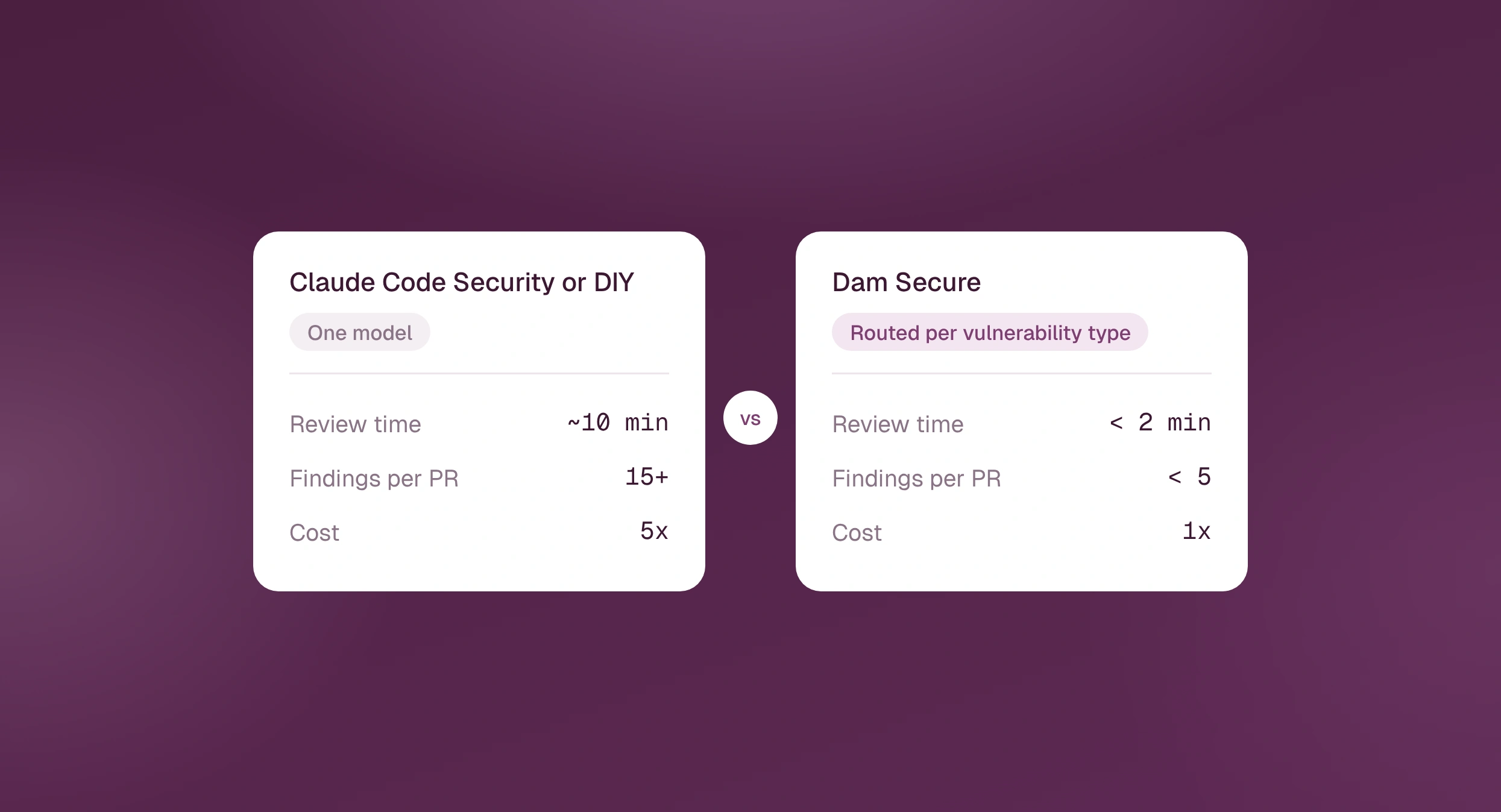
Here's how they compare on the things that matter once you're running them on every PR.
The reason this choice keeps coming up is volume. Agents opened more than 40% of GitHub pull requests in September, up from 17% in March.
At one mid-sized B2B company, Carnegie Mellon and Stanford researchers found PR volume grew 3.1x while the reviewer pool grew 1.5x, and the share of PRs that got a substantive human review fell from about 39% to 21%. Whatever you pick has to hold up on every PR, not just the risky-looking ones.
What actually matters when you compare
Cost per pull request is where the gap is widest. In our September 2026 benchmark, among the models that found more than half the planted vulnerabilities, one review cost anywhere from $0.42 to $11.08, and the cheapest found as many as one of the most expensive.
A team opening 1,000 PRs a month can spend more than $130k a year on tokens if it picks the wrong one. Anthropic says Claude Code Review averages $15-25 a review.
Consistency and memory come next. Run the same PR through a DIY setup twice and you'll often get different findings and different severities. PR comments get resolved, ignored or buried under a force-push, so every review starts from zero and developers learn to dismiss the same findings faster.
Then noise and speed. A review that flags everything trains developers to ignore it, so count how many findings you get for every real one.
And most teams stop waiting for a security review after about 7 minutes. Claude Code Security, Codex and DIY setups take around 10. Dam Secure reviews finish in under two.
When building it yourself makes sense
If you're a small team experimenting, a security prompt in CI is a great way to learn what AI can catch, and it'll find real issues. The ceiling arrives when you need consistent severity, reachability, memory and an audit trail.
Each of those needs its own evals and state, and the token bill grows with every step. Patrick wrote about this in The Ceiling for DIY Security Reviews.
When Claude Code Security makes sense
Claude Code Security reasons about a codebase like a security researcher, checks its own findings and suggests patches for a human to approve.
If your organization is standardized on Claude Enterprise and wants deep audits of existing code, it's worth a look.
When a dedicated PR security review tool makes sense
A dedicated tool does one job: reviewing every pull request for security, fast enough that nobody waits, at a cost that doesn't climb with your AI adoption.
It's the better fit when you want every PR covered, when AppSec needs to show what was checked for SOC 2 or customer due diligence, when developers are tired of noisy findings, or when finance has started asking about the token bill.
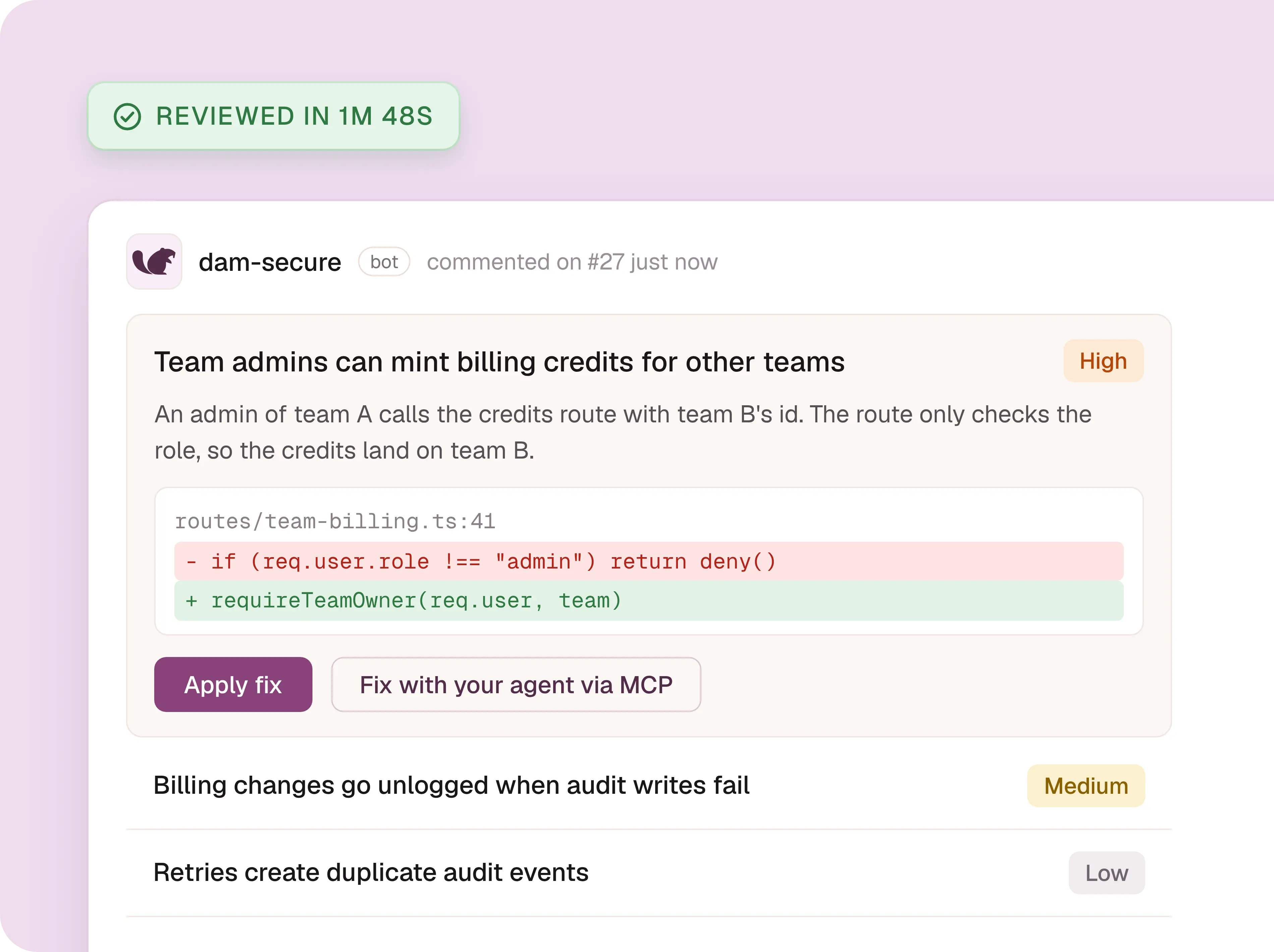
 dam-securebotreviewed in 1m 47s
What Dovetail found when they compared
Dovetail is a user research platform whose customers include roughly 40% of the Fortune 500, and those customers put vendors through months of security due diligence.
Its engineering team was using Claude Code Security as its main PR security check. It was useful, but noisy and expensive, and findings needed a lot of manual triage.
They ran Dam Secure on every pull request alongside Claude Code Security, on the same workload.
Dam Secure caught issues Claude Code Security missed, including a critical vulnerability in a long-standing feature, and Dovetail switched to Dam Secure for PR security review. Findings now flow into Linear as tickets and stay in sync as they're fixed.
"Dam Secure is far better than what we were getting from Claude Code Security." Sebastian Vaughan, Platform Engineering Manager, Dovetail
"Shortly after set-up, Dam Secure found a critical finding in a long-standing feature. It paid for itself very quickly." Doug Rathbone, VP of Engineering, Dovetail
Read the full Dovetail case study.
FAQ
Does Dam Secure use frontier models?
Yes. We benchmark frontier models on real security findings and route each review to the one that's best for that language and vulnerability type. You get frontier-model findings without paying frontier-model token prices.
Can I run Dam Secure alongside Claude Code Security?
Yes. That's how Dovetail evaluated it: both on the same pull requests, then a decision based on what each caught.
How much does AI PR security review cost?
In our benchmark, model costs alone ran from $0.42 to $11.08 per PR, and multi-step DIY setups cost more again. Dam Secure PR reviews cost a fifth of a DIY setup.
Is Claude Code Review the same as Claude Code Security?
No. Claude Code Review is Anthropic's AI code review on pull requests, averaging $15-25 a review, according to Anthropic. Claude Code Security is its product for deeper audits of existing code.
Is /security-review the same as Claude Code Security?
No. /security-review is a command you run inside Claude Code. Claude Code Security is a separate product.
Want to compare Dam Secure on your own PRs? Speak to our team.