How codebase context cuts false positives in code security

Summary
Code security tools that understand codebase context know where authentication happens, how data flows, what's exposed and what your team has already decided is safe. They use that to dismiss findings the rest of the code already handles, and to catch logic flaws that no single line reveals.
Research shows combining LLMs with static analysis can remove 94 to 98% of false positives. AI-native tools with a codebase graph, such as Dam Secure, go furthest.
What is codebase context in code security?
Codebase context is what a tool understands about your application beyond the line it's flagging: how services connect, where authentication happens, which data each endpoint touches, what's exposed to the internet, and what your team has already decided is safe.
It's the difference between "this line looks like SQL injection" and "this input is already validated by the request schema, so it isn't."
Why do security tools without context produce false positives?
Traditional SAST flags any code that matches a risky pattern. To avoid missing real issues, it assumes the worst about paths it can't fully follow. Researchers list over-approximation of infeasible paths and limited understanding of developer intent among the recurring causes of false positives.
The cost shows up in triage time. In a 2026 industry study at Tencent, engineers spent 10 to 20 minutes checking each static analysis alarm by hand. One practitioner quoted in a Black Hat Europe talk estimated about 80% of one tool's findings were false positives.
For AI-written code the problem gets worse. Agents produce more code, so pattern tools produce more alerts, and the context needed to dismiss them is usually in a different file from the line being flagged.
What does codebase context change?
With context, a tool can settle most findings the way a senior engineer would, by looking at the rest of the code.
The results are large. Combining LLMs with static analysis removed 94 to 98% of false positives in the Tencent study. CyberArk researchers who layered an LLM on CodeQL results reported up to a 96% reduction for some issue types.
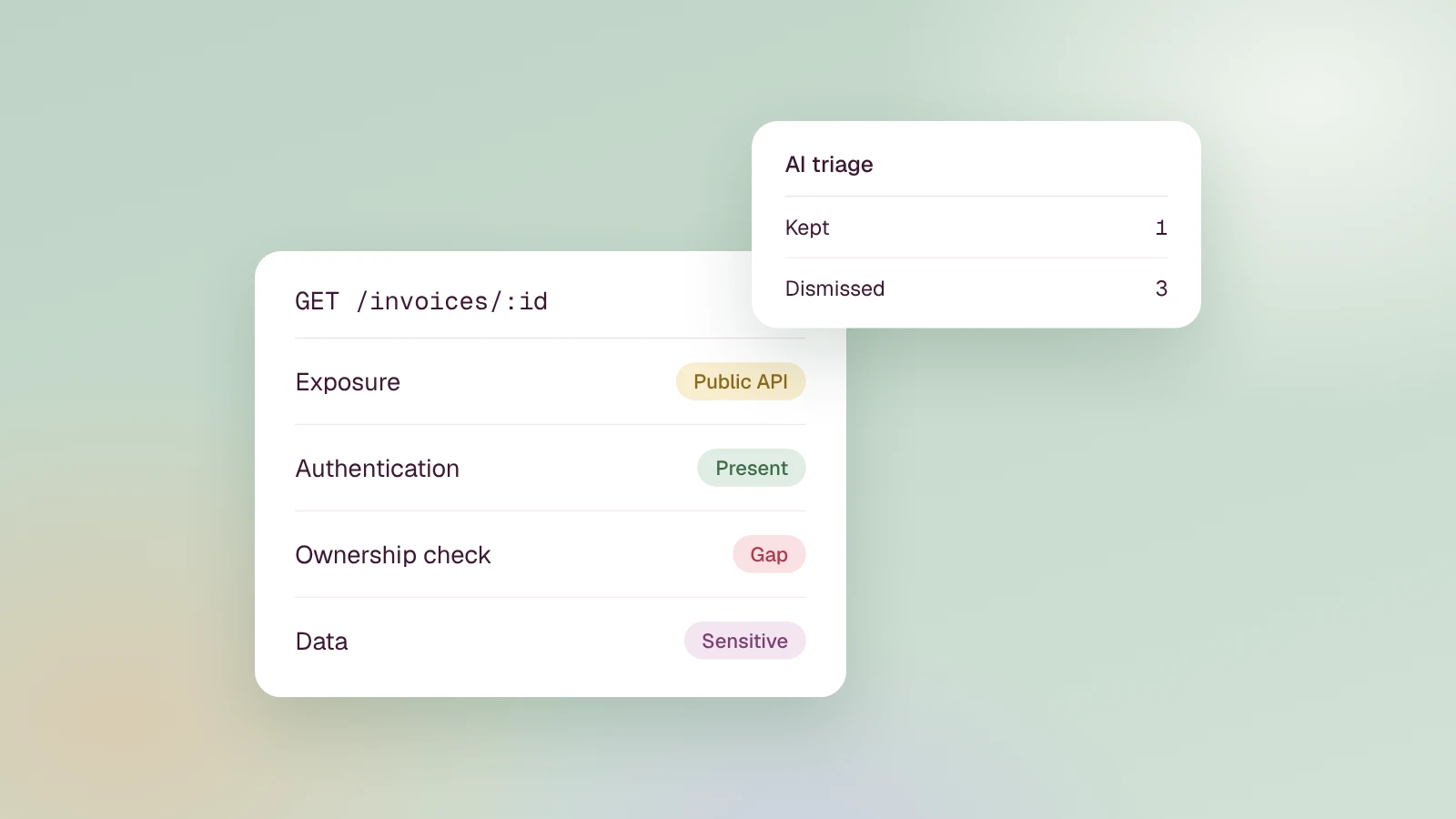
Context also helps in the other direction. The IDOR row above is a real issue that a pattern tool usually misses, because nothing about that one line looks dangerous. It only stands out next to the six routes that do check ownership.
Which code security tools understand codebase context?
Tools fall into three broad approaches.
1. Pattern-based SAST
Rule engines that match known vulnerability patterns and trace data flow. Fast and predictable, but they need per-project tuning to keep noise down.
2. SAST plus an AI triage layer
Traditional engines with an AI step that reviews each alert. Many incumbents now offer one. Checkmarx, for example, lists an AI triage agent as part of Checkmarx One. These cut noise alert by alert, but the underlying scan still decides what gets flagged.
3. AI-native review with a codebase graph
Tools that build a model of your whole codebase first, then review changes against it. Dam Secure, Corgea and ZeroPath take AI-native approaches. These can both dismiss false positives and catch logic flaws that have no pattern.
How do you test whether a tool really uses context?
- Plant a safe-looking false positive. Add input validation in middleware, then a query that looks injectable in another file. A context-aware tool shouldn't flag it.
- Plant a pattern-free flaw. Add an endpoint that skips an ownership check every similar endpoint performs. A context-aware tool should catch it.
- Dismiss with a reason and re-run. A tool that remembers your team's decisions won't flag the same thing next week.
- Count findings per PR on live code. Context should show up as a handful of real findings, not a wall of comments.
How does Dam Secure fit?
When you connect a repository, Dam Secure builds a security knowledge graph of your services, data flows, auth patterns and exposure. Every review and every finding uses it.
AI triage checks each finding against that graph before it's posted, keeping, lowering or dismissing it. Dismissals your team makes with a reason carry into future reviews. The result is fewer than five findings per PR against the 15 or more common with other tools, in under two minutes.
AI-Native SAST applies the same context to existing code whenever you trigger a full review. It costs about a fifth of Claude Code Security or a DIY setup.
As Doug Rathbone at Dovetail puts it: "Dam Secure is the equivalent of a principal security engineer reviewing every change, making sure it's ready for production."
FAQ
What is a context-aware SAST tool?
A SAST tool that understands your wider codebase, such as auth middleware, data flows and service exposure, and uses it to decide whether a finding is real and how serious it is.
Which SAST tools have the fewest false positives for AI-generated code?
Tools that check findings against codebase context before showing them, such as AI-native tools like Dam Secure, Corgea and ZeroPath. Test them on your own repos, since results vary by codebase.
Can AI triage remove false positives from my existing scanner?
It can reduce them. AI triage layers review each alert, but the underlying scanner still decides what gets flagged in the first place, and logic flaws it never flagged stay missed.
Does more context mean slower reviews?
Not when the context is built ahead of time. Dam Secure builds its knowledge graph when you connect a repo, so PR reviews still finish in under two minutes.
Want to see it on your own PRs? Speak to our team.