How to compare PR security review tools: a scorecard for SaaS teams

Summary
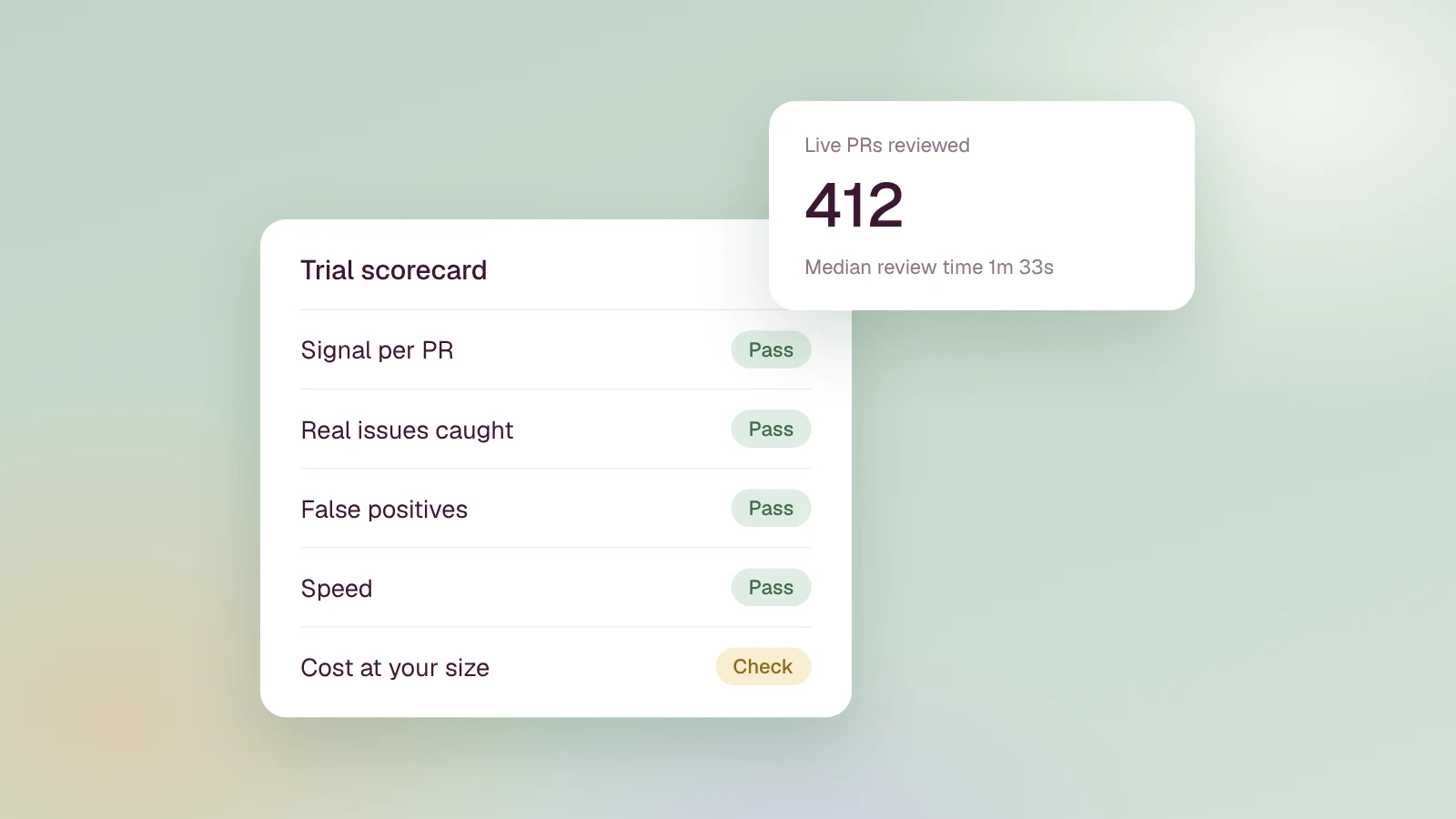
To compare PR security review tools, test seven things on your own repos: findings per PR, real issues caught, false positives, time to review, fix quality, whether the tool learns from dismissals, and cost at your real size.
For mid-market SaaS teams without a large AppSec team, signal per PR and false positives matter most, because they decide whether developers read the findings at all.
What should you compare in a PR security review tool?
Most comparison pages list features. Features don't tell you whether developers will act on the findings, and that's what decides whether the tool makes your code safer.
For a mid-market SaaS team, usually without a large AppSec team, these seven criteria matter most.
1. Signal per PR
Count the average number of findings each tool posts on real PRs. If a one-line change gets a dozen comments, developers learn to scroll past them, and the real issue gets scrolled past too.
2. Real issues caught
Seed your trial with flaws you already know about: past security fixes, pentest findings, an endpoint that once skipped an ownership check. Pattern-based tools are good at injection. The gap shows up on access control and business logic.
3. False positives
Have the PR author mark each finding as real or not. This is the number that predicts adoption. Ask vendors how findings are checked before they're posted, and test it yourself.
4. Speed
Time from PR opened to review posted. A review that lands in two minutes gets fixed while the change is still in the author's head. One that lands after they've moved on gets deferred.
5. Fix quality
Apply the suggested fixes exactly as written. Do they compile, pass tests and actually close the issue? Good fixes are ones a developer, or their coding agent, can commit in one click.
6. Learning
Dismiss a finding with a reason, then open a similar PR. If the tool flags the same thing again, your team will spend every week re-dismissing the same noise.
7. Cost at your size
Price every option at your actual developer count and PR volume, including any per-review, token or CI minute charges. The pricing model matters as much as the list price.
How do pricing models compare?
The same team can pay very different amounts depending on how a tool charges. Anthropic says Claude Code Review averages $15 to $25 per review. GitHub Code Security charges $30 per active committer per month.
As agents write more of your code, PR volume tends to climb faster than headcount. Per-review pricing grows with it. Check what each model costs if your PR volume doubles next year.
How do you run a fair trial?
1. Pick two or three repos
Include one service with authentication and multi-tenant data. Use repos where your developers are actively shipping.
2. Run tools side by side for two weeks
Turn each tool on for the same live PRs, so you're comparing like with like.
3. Let developers score findings
The PR author is the best judge of whether a finding is real. Keep it to a one-click real or not real.
4. Check what each tool hid
Low noise is only good if real issues survive. Look at what each tool filtered out or auto-dismissed.
5. Score against the seven criteria
Weight signal and false positives highest if you don't have a dedicated AppSec team. Those two decide whether anyone reads the findings.
Why does this matter more in 2026?
Automated security review on every PR is becoming standard practice. OpenAI now runs an automated security review on every engineer's PR, and the model can block a merge when it finds a vulnerability. With coding agents opening more PRs every week, human-only security review can't keep up.
How does Dam Secure fit?
 dam-securebotreviewed in 1m 33s
Dam Secure is built around the criteria above. Nine review agents check each PR, with each review routed to the best model for that language and vulnerability type. Reviews take under two minutes and post fewer than five findings per PR, against the 15 or more common with other tools.
A security knowledge graph of your codebase lets reviews catch logic flaws like a role taken straight from the request body. AI triage checks every finding against your code before it's posted, and dismissals your team makes with a reason carry into future reviews.
It costs about a fifth of Claude Code Security or a DIY setup, priced by repo size, so cost stays flat as PR volume grows. See how PR Security Reviews work.
As Doug Rathbone at Dovetail puts it: "Dam Secure is the equivalent of a principal security engineer reviewing every change, making sure it's ready for production."
FAQ
What's the most important metric when comparing PR security review tools?
The share of findings developers actually fix. A tool that posts a few real findings per PR will improve security more than one that posts many findings developers ignore.
How long should a PR security review tool trial take?
Two weeks on live PRs in two or three active repos is usually enough to compare signal, false positives and speed.
Which pricing model is cheapest for a mid-market SaaS team?
It depends on PR volume. Per-review pricing climbs with every PR, and per-developer pricing climbs with headcount. Price each option at your real numbers, and at double your current PR volume.
Can AI security review replace human security review?
It can handle the review on every PR, which no human team can match at today's volume. Humans stay essential for threat modeling, design reviews and the findings that need judgment.
Want to see it on your own PRs? Speak to our team.