Mythos-level attacks: how to get your codebase ready when AI finds vulnerabilities in minutes

Summary
In early 2026, Anthropic showed what a frontier model can do when you point it at real code. Claude Mythos Preview found thousands of high and critical vulnerabilities across every major operating system and browser, some of which had survived decades of human review.
That work ran under Project Glasswing, a controlled program built to get those flaws fixed before attackers found them. Good news for anyone running Firefox or OpenBSD.
The uncomfortable part is what it means for everyone else's code. If a model can find a 27-year-old flaw in OpenBSD, it can find the missing org check in your billing API.
Security leads raise this with us on almost every call now, usually in the same breath as "we already can't fix what we find fast enough."
This post is about what a mid-size SaaS team can actually do about it. Short version: use the same class of models on your own code first, and make fixing faster than finding.
Finding vulnerabilities got cheap
In its first month, Glasswing surfaced more than 10,000 high and critical vulnerabilities. Mozilla fixed 271 in Firefox 150 alone, more than ten times what it found in Firefox 148 with the previous Claude model.
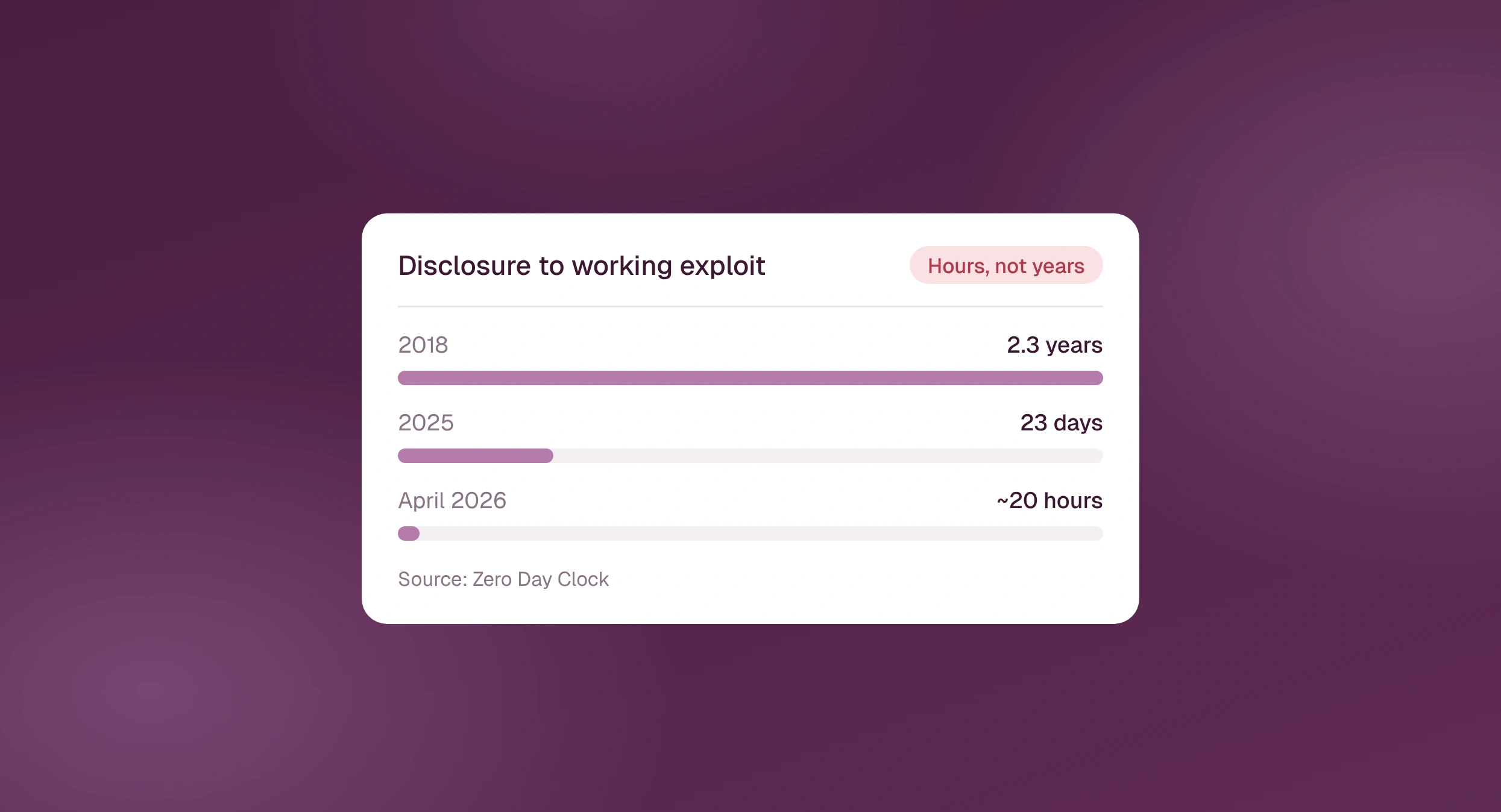
Exploiting them got faster too. The Zero Day Clock tracked the average gap between a vulnerability being disclosed and a confirmed exploit at 2.3 years in 2018.
By April 2026 it was about 20 hours. And Mythos-level capability won't stay with the labs that built it. One policy analysis put attackers at that level by November 2026, which is roughly now.
The breach data is already moving that way. In Verizon's 2026 Data Breach Investigations Report, exploiting a vulnerability was how 31% of breaches started, up from 20% the year before.
Only 26% of known exploited vulnerabilities were fully fixed, and the median time to fix one went from 32 days to 43.
Mandiant's M-Trends 2026 found the same thing from the incident response side: exploits were the most common way in, at 32% of the intrusions it investigated.
What it means if you don't ship an operating system
Most SaaS companies aren't on anyone's zero-day research list. They don't need to be. When an attacker can point a capable model at your public API or a leaked repo for a few dollars, your backlog becomes your attack surface.
The medium-severity IDOR you parked in Q3 is now an afternoon's work for someone else.
The teams we talk to have far more findings than time to fix them. One AppSec lead told us their 24, 48 and 72-hour remediation SLAs just aren't as fast as attackers anymore. Another expects open-weight models to reach this level within months.
What to do about it
- Point frontier models at your own code first. Run a deep review of your whole codebase, not a pattern scan, and start with what's reachable from the internet.
- Stop adding to the pile. Put a security review on every pull request, not just the ones that look risky. Agents opened more than 40% of GitHub pull requests in September, and that number only goes one way.
- Rank by what's exploitable. A backlog of 400 unranked findings doesn't get fixed in 20 hours. Triage for reachability and existing mitigations so the team starts on what matters.
- Fix where the code is. Put the fix on the PR, or hand it straight to the developer's coding agent. Track time to fix as closely as you track findings.
- Patch dependencies like the clock is running. Once an advisory drops, assume exploitation is hours away. Our npm post covers one cheap way to buy time.
- Keep doing the boring stuff. Phishing-resistant MFA, least privilege, segmentation and egress controls still raise the cost of every attack, AI-assisted or not.
Where Dam Secure fits
 Internet-facing first
This is the problem we built Dam Secure for. We benchmark frontier models on real security findings and route each review to the model that's best at finding that type of vulnerability, so you get frontier-model results without paying frontier-model token prices.
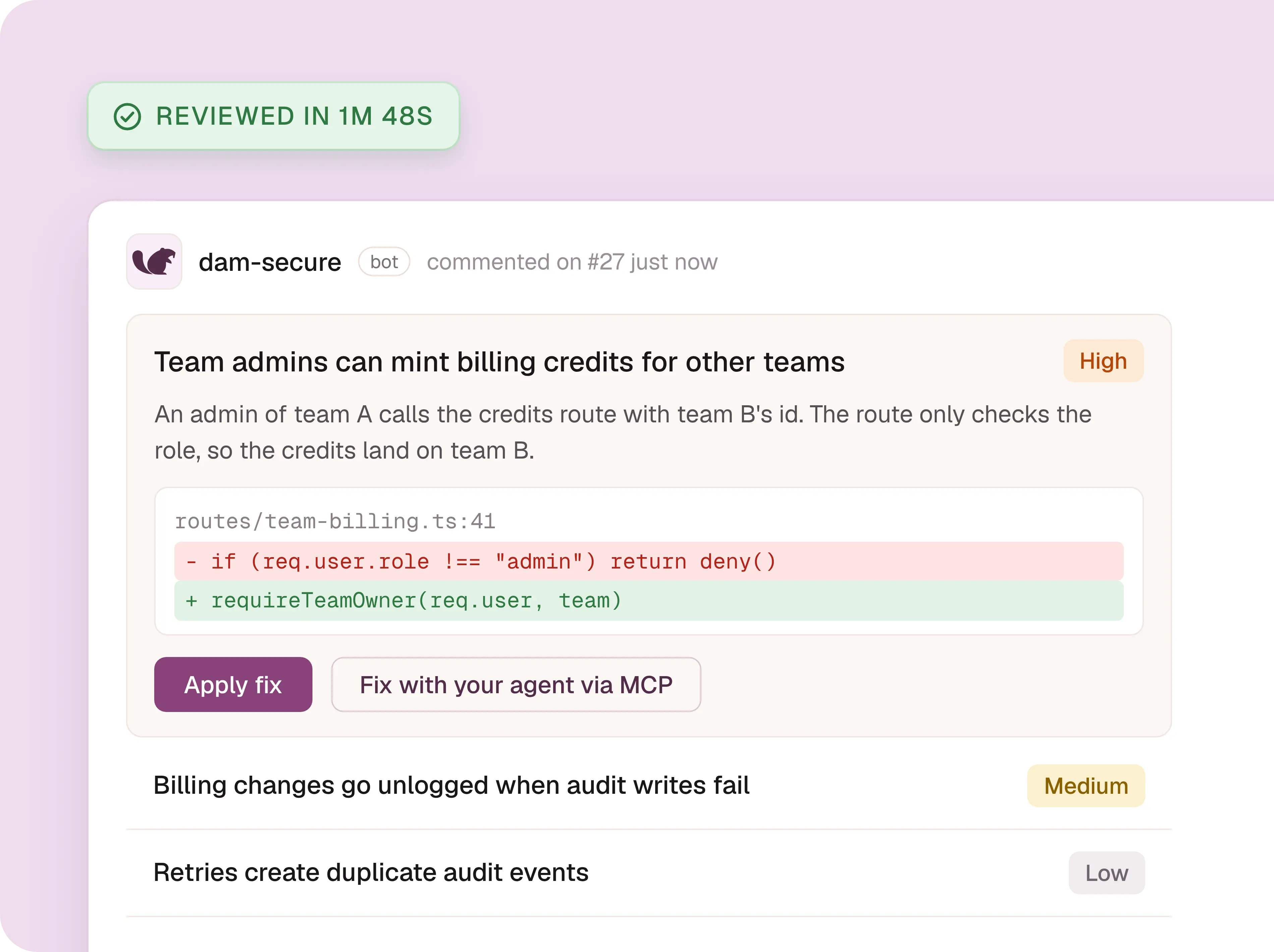
AI-Native SAST reviews your whole codebase and triages every finding for reachability. PR Security Reviews check every pull request in under two minutes, with the fix included.
Dependency Security tells you which repos are exposed when a new advisory lands. And every fix becomes security context your coding agents follow, so the same flaw doesn't get written twice.
"Shortly after set-up, Dam Secure found a critical finding in a long-standing feature. It paid for itself very quickly." Doug Rathbone, VP of Engineering, Dovetail
Start with the code that faces the internet, and start this quarter.
FAQ
What is Claude Mythos?
A frontier model Anthropic announced in April 2026 with unusually strong ability to find and exploit software vulnerabilities. Access is limited to partners in Project Glasswing.
What are Mythos-level attacks?
Attacks that use AI at that level of capability to find and exploit vulnerabilities faster and more cheaply than human researchers. The term covers any model that gets there, not just Anthropic's.
What should a SaaS team do first?
Get a deep review of your existing codebase, starting with what's reachable from the internet, and put a security review on every pull request so new code doesn't add to the pile.
Want frontier models on your side first? Speak to our team.