How to prioritize vulnerabilities across all your repos

Summary
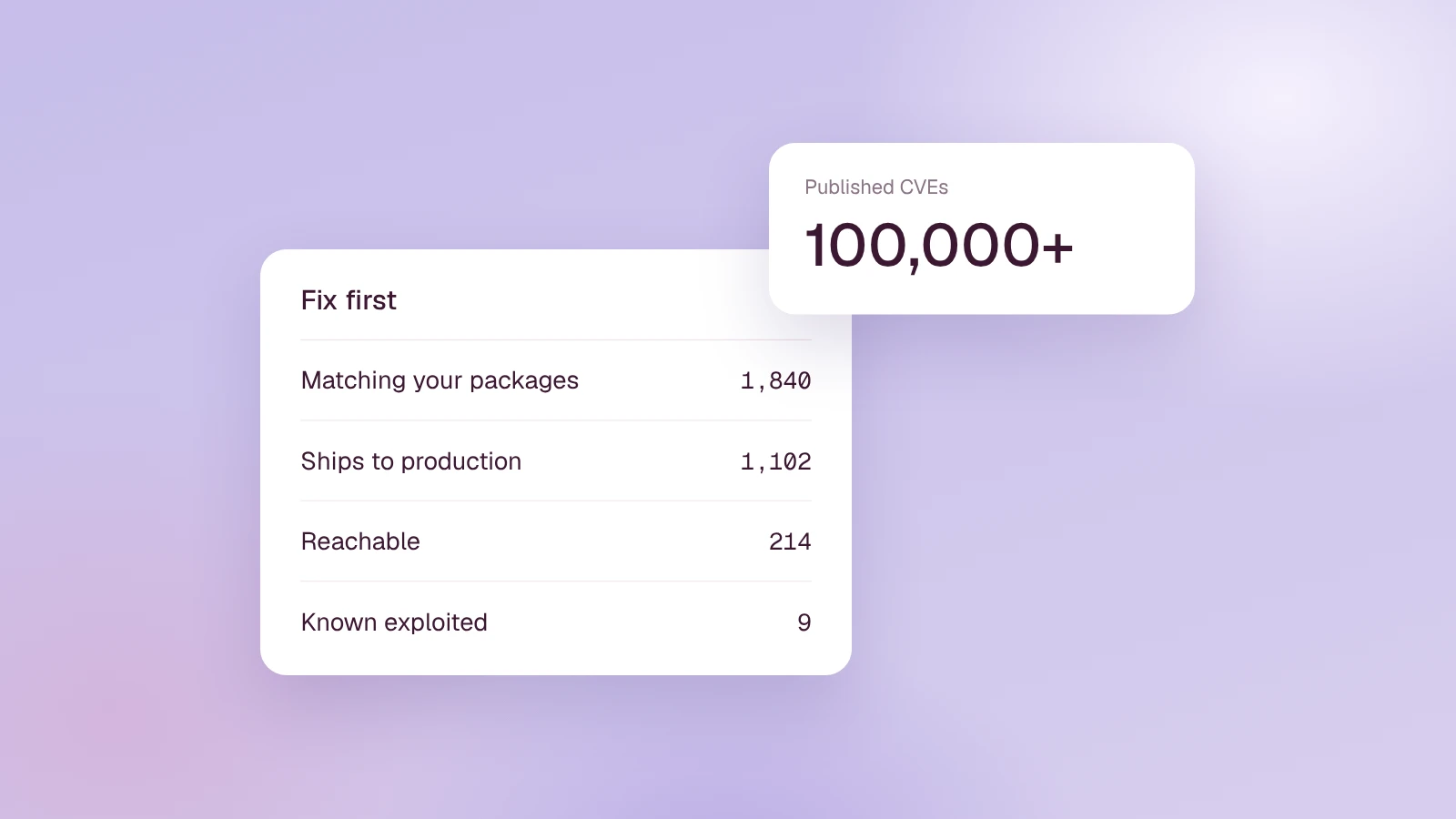
To prioritize vulnerabilities across many repositories, focus on repos that ship to production, keep the issues your code can actually reach, put known exploited vulnerabilities first, weight by internet exposure and data sensitivity, then group the work by fix and route it to each repo's owner.
Severity scores alone don't work in 2026. Over 100,000 CVEs were published by mid-November, only about 1.4% are known to be exploited, and attackers are reaching the ones they use faster than before.
Why can't teams patch everything anymore?
Because there's too much of it. VulnCheck counted over 100,000 CVEs published in 2026 by mid-November, more than double all of 2025, with AI-driven research behind much of the jump. Only about 1.4% of this year's CVEs are in VulnCheck's catalog of known exploited vulnerabilities.
Attackers are also moving faster on the ones they use. The median time from CVE publication to known exploitation fell from 120 days to 80 in the first half of 2026. This month, a serious UnrealIRCd flaw was exploited about a day after its patch shipped.
Meanwhile, the Verizon 2026 DBIR found only 26% of known exploited vulnerabilities were fully remediated, with median time to resolution up to 43 days. Ranking by severity score alone means patching the wrong things first.
How do you prioritize vulnerabilities across many repos?
Narrow the list in stages, so your team spends its time on the small set that matters.
1. Start from what ships
Archived repos, prototypes and test-only code don't carry the same risk as the services customers use. Tag repos by whether they ship to production and focus there first.
2. Check reachability
A vulnerable function in a dependency only matters if your code calls it. Reachability analysis cuts dependency advisories down to the ones attackers could actually trigger.
3. Weight known exploitation
Anything in the CISA KEV catalog or a similar list goes to the top, whatever its CVSS score. EPSS adds a forward-looking estimate of how likely exploitation is in the next 30 days.
4. Factor in exposure and data
An issue in a public API that touches customer data outranks the same issue in an internal admin tool behind SSO. This needs context about your services, not just the CVE.
5. Group by fix
One upgrade can clear dozens of advisories across many repos. Planning work by fix, instead of by advisory, turns an endless list into a short one.
6. Route to an owner
Every finding needs a team that owns the repo. Unowned findings are the ones that sit open for months.
What about vulnerabilities in your own code?
Dependency advisories are only half the picture. Flaws in your own code, especially access control and business logic, have no CVE to look up. The same questions apply, though: is it reachable, what data does it touch, and who can trigger it?
The cheapest place to answer those questions is the PR. A finding caught before merge never needs to be prioritized against 100,000 others.
How does Dam Secure fit?
Dam Secure prioritizes with context from your codebase. A security knowledge graph maps your services, data flows and auth patterns, and AI triage uses it to keep, lower or dismiss each finding. A flaw only admins can reach gets lowered. Test-only code gets dismissed.
AI-Native SAST runs full reviews of existing code across your repos whenever you trigger one, so the flaws already in your codebase get the same context-based prioritization, including access control and logic flaws that have no CVE.
Dependency Security checks every package across your repos against known advisories and groups findings by the version that fixes them. PR Security Reviews catch new flaws before they merge, with fewer than five findings per PR in under two minutes.
It costs about a fifth of Claude Code Security or a DIY setup, priced by repo size.
As Doug Rathbone at Dovetail puts it: "Dam Secure is the equivalent of a principal security engineer reviewing every change, making sure it's ready for production."
FAQ
How many CVEs have been published in 2026?
VulnCheck counted 100,222 CVEs published in 2026 as of mid-November, more than double 2025's total.
Is CVSS enough to prioritize vulnerabilities?
No. CVSS rates how bad a flaw could be in general. Prioritizing well also needs exploitation data, reachability, exposure and what data the affected code can reach.
What's the difference between KEV and EPSS?
KEV catalogs list vulnerabilities already being exploited. EPSS estimates the probability a vulnerability will be exploited in the next 30 days. Use KEV to act now and EPSS to plan ahead.
How do you prioritize vulnerabilities across many repositories?
Focus on repos that ship to production, keep only reachable issues, put known exploited ones first, weight by exposure and data, then group the work by fix and route it to repo owners.
Want to see it on your own PRs? Speak to our team.