SAST vs DAST vs SCA: what each one catches, and where AI-native SAST fits

Summary
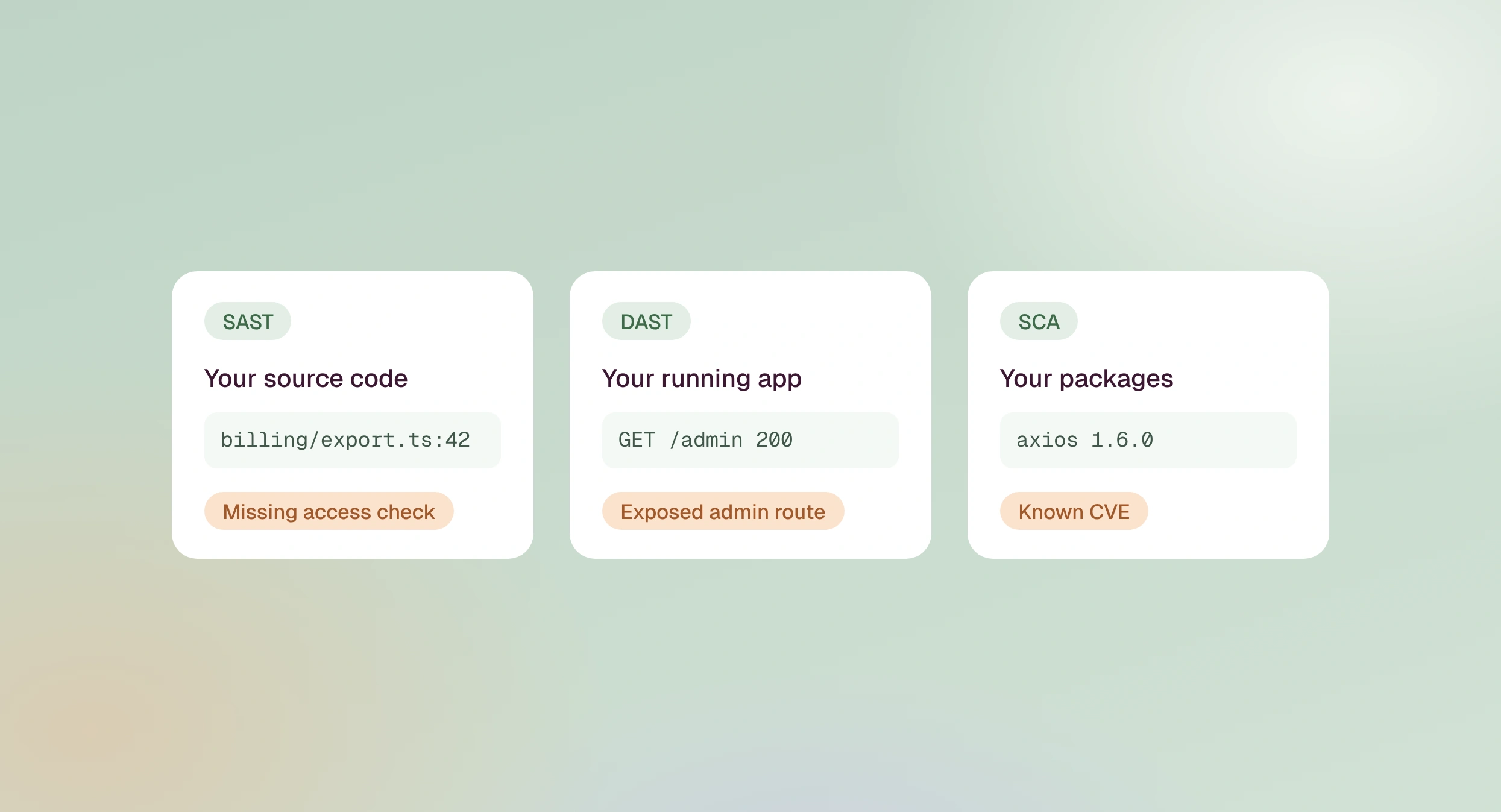
SAST reads your source code. DAST pokes at your running application from the outside. SCA checks the open source packages you depend on against known vulnerabilities. They catch different things, and most teams need all three in some form.
The practical setup for a mid-size SaaS team: SAST and SCA on every pull request, DAST against staging before big releases. If AI agents are writing a lot of your code, the one to get right is SAST, because the flaws agents introduce most often live in your own code and don't look like flaws.
The three side by side
SAST
Static application security testing reads your code without running it. That's its big advantage: it can point at the exact file and line of code that caused a problem, and it can run on every pull request before anything ships.
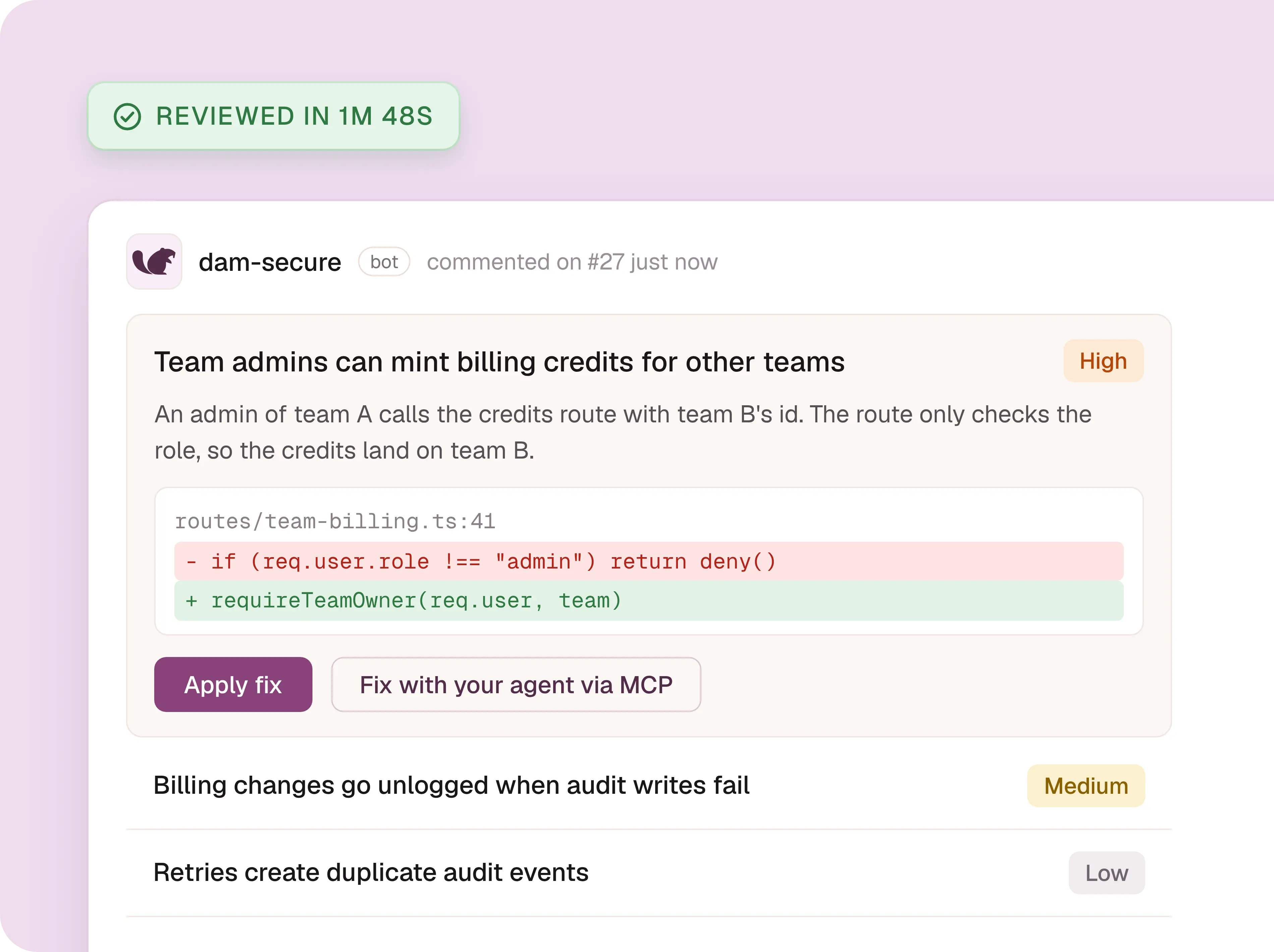
Traditional SAST works by pattern matching. It flags code that looks like a known vulnerability, like user input joined straight into a SQL query. That's useful, and it's also why so many teams have stopped reading their SAST results. It flags plenty of code that looks risky but isn't reachable. And it misses the flaws that don't look like anything, like a delete endpoint that checks you're signed in but not that you're an admin of that team.
And there's more code to check than ever. A 2026 study of 302,600 AI-authored commits across 6,299 GitHub repos found AI introduced about 1.5 times as many security issues as it fixed.
DAST
Dynamic application security testing behaves like an attacker. It sends requests, fuzzes inputs and watches what comes back from a running app. It's good at things that only exist once code is deployed, like a misconfigured header or an admin route someone left open.
The catch is timing. DAST needs a running environment, so it usually runs after code has merged. And when it finds something, it tells you which request misbehaved, not which line of code to change. Someone still has to go and find it.
SCA
Software composition analysis reads your lockfiles and matches every package version against published advisories. Running a version with a known CVE? SCA tells you which package, which repos, and which version fixes it.
It matters more every month. A package you installed a year ago can have a vulnerability disclosed tomorrow, even though your code never changed. And coding agents add packages as they go, so it's easy to end up depending on something nobody picked on purpose.
And slow patching is what attackers count on. In Verizon's 2026 Data Breach Investigations Report, exploiting a vulnerability was how 31% of breaches started, up from 20% the year before, and the median time to fix a known exploited vulnerability was 43 days.
Where AI-native SAST fits
AI-native SAST keeps what's good about SAST (it reads the code, it points at the line, it runs on every PR) and fixes the two things that made teams tune it out.
First, it reasons about behavior instead of matching patterns. It can tell that every other route in a service checks team ownership and this one doesn't, which is exactly the kind of business logic flaw pattern matching can't see.
Second, it triages before anyone looks. A SQL injection behind an admin-only, audit-logged route gets ranked below one on a public endpoint, instead of both turning up as red.
That's how Dam Secure's AI-Native SAST works. It maps how your codebase fits together first, then reviews your default branch and every new pull request against that map.
Teams uncover 40% more exploitable vulnerabilities than their last scanner found, with 3x less noise. Exposed secrets and vulnerable dependencies land in the same backlog, so your SAST and SCA findings aren't split across two tools that don't talk to each other.
How we'd set it up
If we were starting from scratch at a 50-to-200-developer SaaS company, we'd run AI-native SAST and SCA on every pull request, because both are fast enough to run before merge and both tell the developer exactly what to change. We'd re-check every repo for vulnerable dependencies whenever a new advisory drops, not just the ones with open PRs.
We'd run a full SAST review of the default branch once, to see what's already there. And we'd run DAST against staging before major releases, to catch configuration issues the code alone can't show.
FAQ
Is SAST or DAST better?
Neither replaces the other. If you can only start with one, start with SAST, because it runs on every pull request and tells you exactly where to fix things.
What's the difference between SAST and SCA?
SAST reviews the code your team (and your agents) wrote. SCA reviews the open source code you depend on.
Do I still need DAST if I use AI-native SAST?
For most teams, yes, before major releases. AI-native SAST closes the gap on logic and access control flaws, while DAST still catches misconfigurations in deployed environments.
Want one backlog for your code, secrets and dependencies? Speak to our team.