How to security review every PR without adding headcount

Summary
To security review every PR without adding headcount, automate the review on every PR, keep human reviewers on the riskiest changes like auth and payments, train security champions, give coding agents your security rules up front, and measure what gets fixed.
The automated review has to be low noise, fast and context-aware, or it creates triage work for the people you were trying not to hire.
Why can't you hire your way to a security review on every PR?
PR volume is growing far faster than any security team. GitHub's Octoverse report found agents started more than 40% of pull requests in September, up from 17% in March, and merged pull requests reached 1.3 billion over the year.
Even a strong security engineer can only read so many diffs a day. When every developer has a coding agent opening PRs around the clock, adding one more reviewer barely moves the line.
The answer for most mid-market teams is to stop trying to put a human on every PR, and decide where human judgment matters most.
How do you review every PR without adding headcount?
1. Automate the review on every PR
Use AI security review as the baseline, so every change gets checked before merge. This is fast becoming standard practice. OpenAI now runs an automated security review on every engineer's PR, and the model can block a merge.
2. Keep humans on the riskiest changes
Route authentication, permissions, payments and personal data to a security champion, using CODEOWNERS or path-based rules. Your security lead's time goes to threat models and design reviews, where people add the most.
3. Train security champions
One engineer per team who knows the security basics and owns that team's findings. It's cheaper than a hire, and it puts security knowledge where the code is written.
4. Give coding agents your rules up front
The cheapest review is the one that finds nothing. When agents know your auth patterns and security standards from the first prompt, fewer issues reach the PR at all.
5. Measure what gets fixed
Track the share of findings developers fix, time to fix, and how many issues get caught before merge. If developers ignore the findings, the coverage is only on paper.
What should you look for in an automated PR security review tool?
If the tool is replacing headcount, it has to behave like a good reviewer.
- Low noise. A handful of real findings per PR. A tool that posts 15 comments on every change creates triage work, which is the headcount problem again.
- Codebase context. It should understand your auth patterns and data flows, so it catches logic flaws, not just known patterns.
- Speed. Reviews in minutes, while the author still has the change in their head.
- Fixes, not just findings. Suggested changes a developer or coding agent can commit in one click.
- Predictable cost. Anthropic says Claude Code Review averages $15 to $25 per review. At hundreds of PRs a week, per-review pricing can rival the cost of a hire.
How does Dam Secure fit?
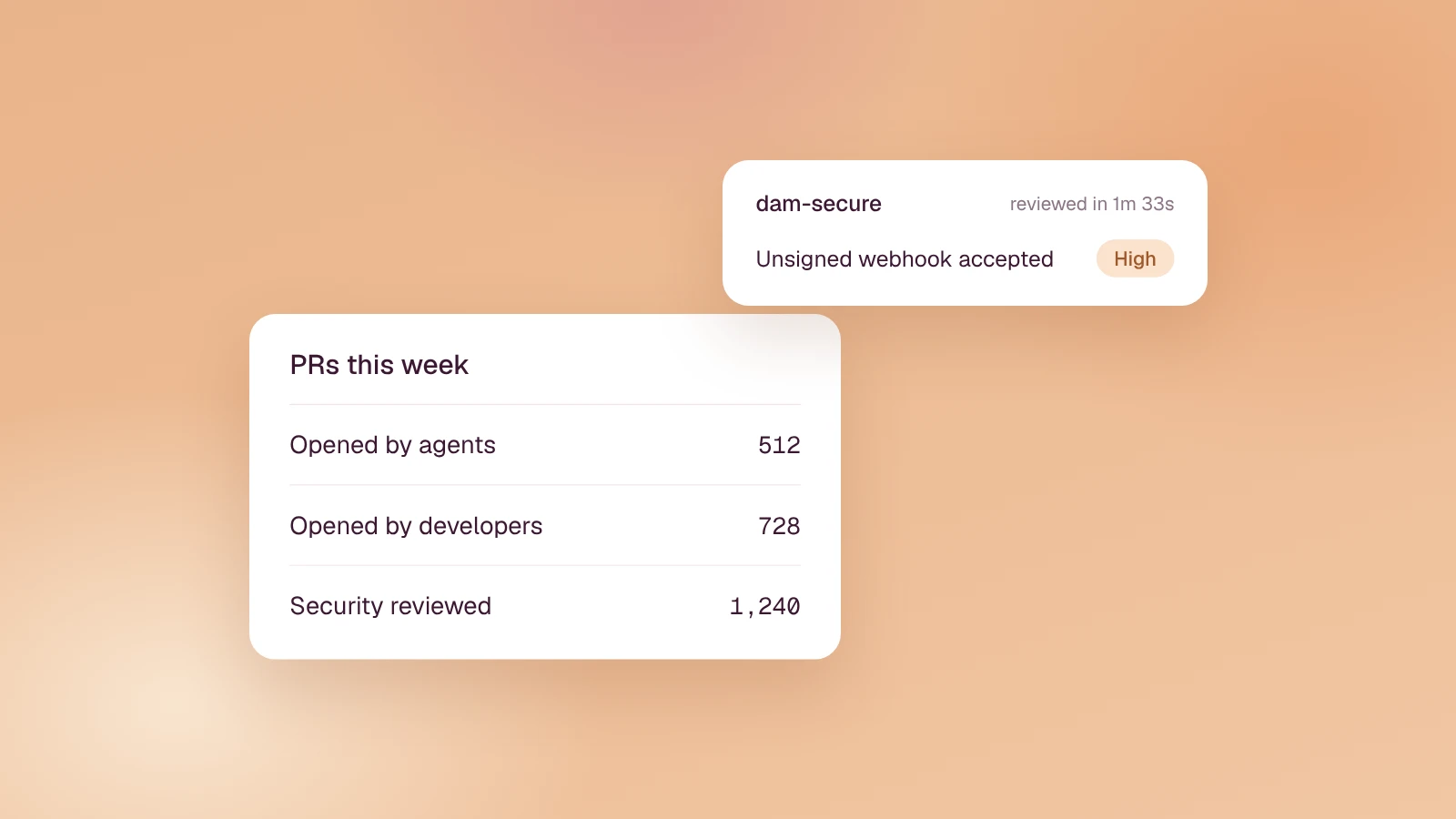
 dam-securebotreviewed in 1m 33s
Dam Secure PR Security Reviews review every PR for security in under two minutes. Nine review agents check each change, with each review routed to the best model for that language and vulnerability type.
AI triage checks every finding against your code before it's posted, so developers see fewer than five findings per PR, against the 15 or more common with other tools. Each one comes with a fix they, or their coding agent, can apply.
Managed Security Context gives every coding agent your security rules from the first prompt. It costs about a fifth of Claude Code Security or a DIY setup, priced by repo size, so it stays flat as PR volume grows.
As Doug Rathbone at Dovetail puts it: "Dam Secure is the equivalent of a principal security engineer reviewing every change, making sure it's ready for production."
FAQ
Can AI replace an AppSec engineer?
No. AI security review can cover every PR, which people can't do at today's volume. Your security team stays essential for threat models, design reviews and judgment calls on the riskiest changes.
What's the best tool to security review every pull request?
Look for a tool that posts a handful of real findings per PR, understands your codebase, reviews in minutes and has predictable pricing. Test it on your own PRs for two weeks before deciding.
What is a security champion?
An engineer on a product team who takes ownership of security basics for that team, reviews its riskiest changes and acts as the link to the security team.
How many PRs are written by AI agents?
GitHub's Octoverse report found agents started more than 40% of pull requests on GitHub in September 2026, up from 17% in March.
Want to see it on your own PRs? Speak to our team.