Best Semgrep alternatives in 2026 (and when AI-native SAST fits)

Summary
The best Semgrep alternatives in 2026 depend on why you want to leave. Opengrep keeps Semgrep's engine for free. CodeQL and SonarQube suit teams that want a different rule-based engine. AI-native SAST tools, such as Dam Secure, Corgea and ZeroPath, suit teams that want fewer false positives and better coverage of business logic flaws.
Semgrep is still a strong tool, and plenty of teams should keep it. This guide covers why teams look elsewhere, how the main options compare, when staying put makes sense, and how to test a replacement on your own code before you commit.
Why do teams look for Semgrep alternatives?
Most teams that start looking have one of four reasons.
- Rule upkeep. Semgrep finds issues by matching code against rules. Rules are fast and predictable, but someone has to write, tune and retire them as the codebase changes. Teams without a dedicated security engineer often find that work never gets done.
- Noise. A pattern match can't tell whether input is attacker-controlled, or whether it was already checked two files away. OWASP lists "high numbers of false positives" as a known weakness of SAST tools in general, and Semgrep is no exception.
- Cost as the team grows. Semgrep's free tier covers up to 10 contributors and 10 private repositories. Past that, the Teams plan starts at $30 per contributor per month for Code, with Supply Chain and Secrets priced separately.
- The licence change. In December 2024, Semgrep moved the rules it maintains to the Semgrep Rules License, which Semgrep itself says is not an open source license. The engine stayed LGPL 2.1, and a group of security vendors forked it as Opengrep.
Semgrep has also added AI. Its Multimodal features combine AI reasoning with rules for detection, triage and fixes. Its AI-powered detection docs list limits worth knowing before you compare: it runs on full scans only, custom rules aren't supported, and its findings are non-deterministic.
What's the difference between rule-based and AI-native SAST?
Rule-based SAST parses code and matches it against known-bad patterns or data flows. Semgrep, Opengrep, CodeQL and SonarQube all work this way. The same code and rules give the same result every time, which helps with audits and CI gates.
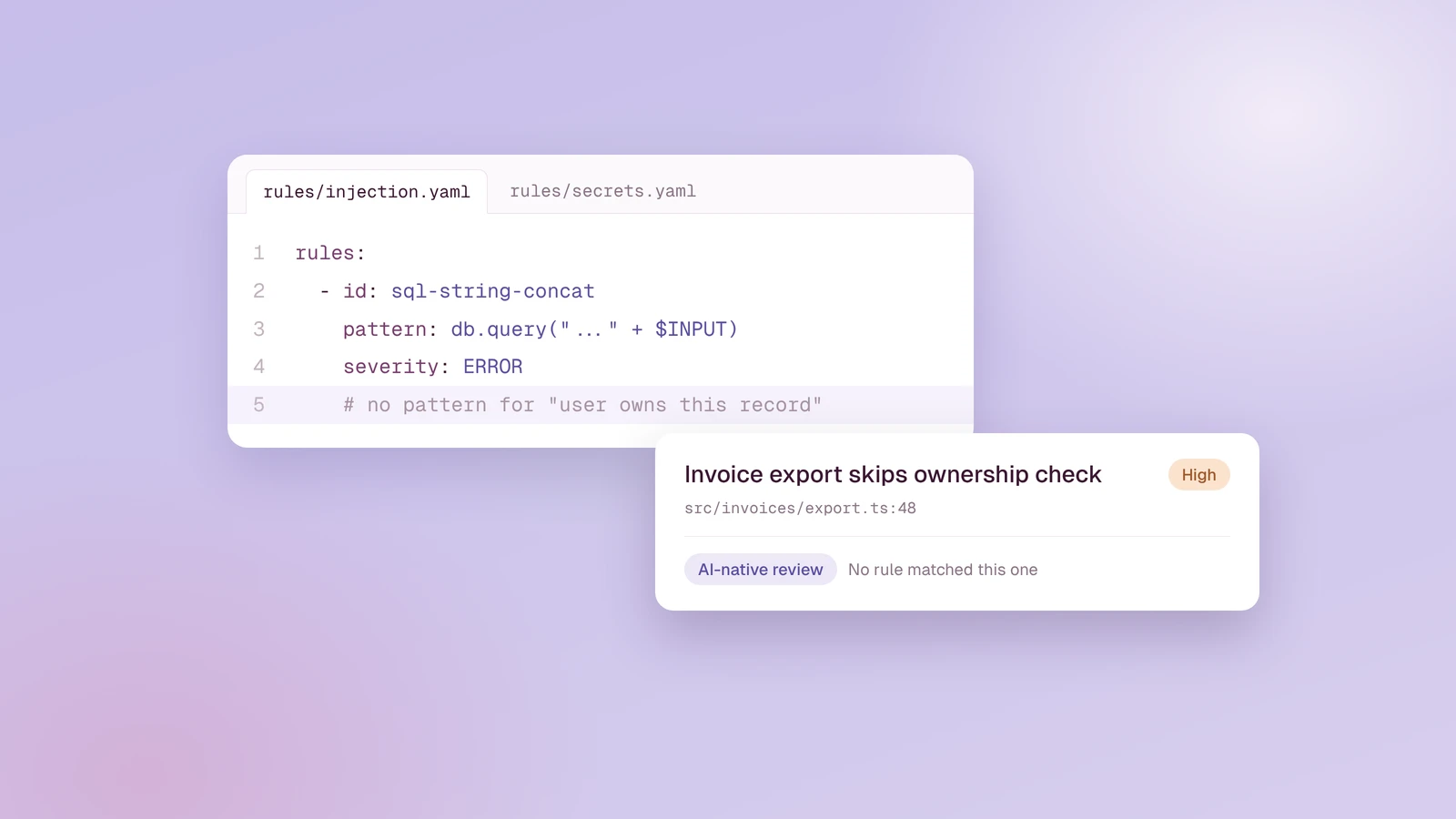
AI-native SAST uses models to read and reason about code as part of finding issues. A model can follow intent across files and ask questions a rule can't express, such as whether an endpoint checks that the user owns the record they're exporting. A rules engine with an AI step added afterwards can only filter what its rules already found.
The difference shows up most in two places.
- Business logic and access control. OWASP notes that SAST tools find it difficult to automate searches for authentication problems and access control issues. These flaws depend on what the code is meant to do, so there's often no pattern to match.
- False positives. In a 2026 industry study at Tencent, engineers spent 10 to 20 minutes checking each static analysis alarm by hand. Combining LLMs with static analysis removed 94 to 98% of false positives, at a cost of $0.0011 to $0.12 per alarm.
AI review isn't automatically better or cheaper, though. A 2026 study of project-scale vulnerability detection found that general-purpose coding agents had the highest recall, but runs used hundreds of thousands to hundreds of millions of tokens, cost more than $1,000 in API charges per project, and took hours to days.
The AI-native tools worth shortlisting are the ones that keep that cost under control.
What are the best Semgrep alternatives in 2026?
Here are the main options, grouped by how they find issues.
1. Opengrep
Opengrep is an open source fork of Semgrep Community Edition, taken at version 1.100.0 and licensed under LGPL 2.1. Endor Labs led the fork, with a group of security companies including Aikido, Jit and Orca Security behind it.
It's the smallest change if licensing is your main concern, and rules your team wrote yourselves are a natural starting point. It doesn't ship its own ruleset or a managed platform, so rule upkeep stays with you.
2. CodeQL (GitHub Code Security)
CodeQL treats code as a database you query, which makes it strong at data-flow analysis. It's built into GitHub, free for public repositories, and part of GitHub Code Security for private ones, which GitHub launched at $30 per active committer per month.
Custom queries mean learning the QL language, and it only fits teams whose code lives on GitHub.
3. SonarQube
SonarQube combines code quality and security rules with quality gates in CI. It suits teams that want one place for maintainability and security hygiene. Security depth varies by edition, so check which checks need a paid tier before you plan around them.
4. Snyk Code
Snyk Code is Snyk's SAST engine, with fast scans in the dev environment and AI-assisted fix suggestions. It fits teams already using Snyk for dependencies. Like the other tools in this group, it still works from patterns and data flows, so coverage of business logic is limited.
5. AI-native SAST: Dam Secure, Corgea and ZeroPath
These tools use models to find issues, then check whether each one is reachable and exploitable before showing it to an engineer. They're the better fit when your backlog is full of false positives, or when your riskiest bugs are in access control and business logic. We compare them in more detail in the best AI-native SAST tools in 2026.
When should you stay on Semgrep?
Switching has a real cost, and Semgrep is the right choice for a lot of teams. Stay if:
- You have a mature set of custom rules that encode your own standards, and someone owns them.
- You need fully deterministic results for audit or compliance evidence.
- Scan time in CI is your hardest constraint.
- You're within the free tier and the noise is manageable.
Many teams keep Semgrep for custom rules and add an AI-native review for logic flaws and triage. That works well, as long as findings end up in one backlog rather than two.
How do you compare Semgrep alternatives fairly?
Vendor comparison pages, ours included, put their own tool first. The result that counts is how each tool does on your code, and a two-week trial is usually enough to find out.
- Pick representative repositories. Choose two or three, including one with authentication and multi-tenant logic.
- Collect known issues. Use past security bugs, pentest findings and fixed advisories from your own code. The OWASP Benchmark is a useful extra test, because every vulnerability it scores is meant to be exploitable.
- Run defaults first. Test each tool before any tuning, so you see what your engineers would see on day one.
- Score the results. Count true positives, false positives and known issues missed, and time how long an engineer takes to confirm or dismiss each finding.
- Check what was hidden. A 2026 study of LLM agents filtering false positives found that aggressive filtering can also suppress real vulnerabilities. Review what each tool auto-dismissed, as well as what it showed.
- Price it at your real size. Use your actual contributor count and scan frequency, including any AI credits or token costs.
How does Dam Secure fit?
Dam Secure is an AI-native SAST option for teams that want fewer, better findings without writing or tuning rules.
When you connect a repository, Dam Secure builds a security knowledge graph of your services, data flows and authentication, which takes 3 to 20 minutes depending on the size of the repository. AI-Native SAST then reviews your whole default branch, and you can run a new full review whenever you need one.
Every finding goes through AI triage. It reads the flagged code and the code around it, works out who could exploit the issue and what they would gain, then keeps the severity, lowers it or dismisses the finding. It never raises a severity.
When you dismiss a finding with a reason, that reason becomes context for future reviews, so the same false positive doesn't come back.
PR security reviews use the same understanding of your code on every pull request, across nine security lenses that include access control, business logic, and AI and agent security. Each review is routed to the model best suited to its language and vulnerability type, so you get frontier-level results without paying the token bill yourself.
Sam Stewart, Head of Security at Serval, put it this way: "Dam Secure costs a quarter of what Claude Code Security does, with way better results."
If you rely on custom Semgrep rules for internal standards, you can keep them running alongside Dam Secure.
FAQ
What is the best free alternative to Semgrep?
Opengrep is the main free option. It's an open source fork of Semgrep Community Edition under LGPL 2.1, so it runs the same kind of rules. CodeQL is also free for public repositories on GitHub.
Is Semgrep still open source?
The Semgrep engine is still licensed under LGPL 2.1. Since December 2024, the rules Semgrep maintains use the Semgrep Rules License, which Semgrep says is not an open source license.
Can AI-native SAST replace Semgrep?
For many teams, yes, especially when rules aren't maintained and most findings are noise. If you depend on custom rules for internal standards or need deterministic results for audits, run both and keep one backlog.
Which Semgrep alternative is best for business logic flaws?
Rule-based tools struggle with business logic because there's usually no pattern to match. AI-native SAST tools reason about what the code is meant to do, so they're better suited. Test them on known bugs from your own code before you decide.
Want to see what Dam Secure finds in your own code? Speak to our team.