The best AI-native SAST tools in 2026

Summary
Every SAST vendor added AI this year. Most of them added it at the end: a rules engine finds things, then a model writes the summary, suggests a fix or hides a few false positives.
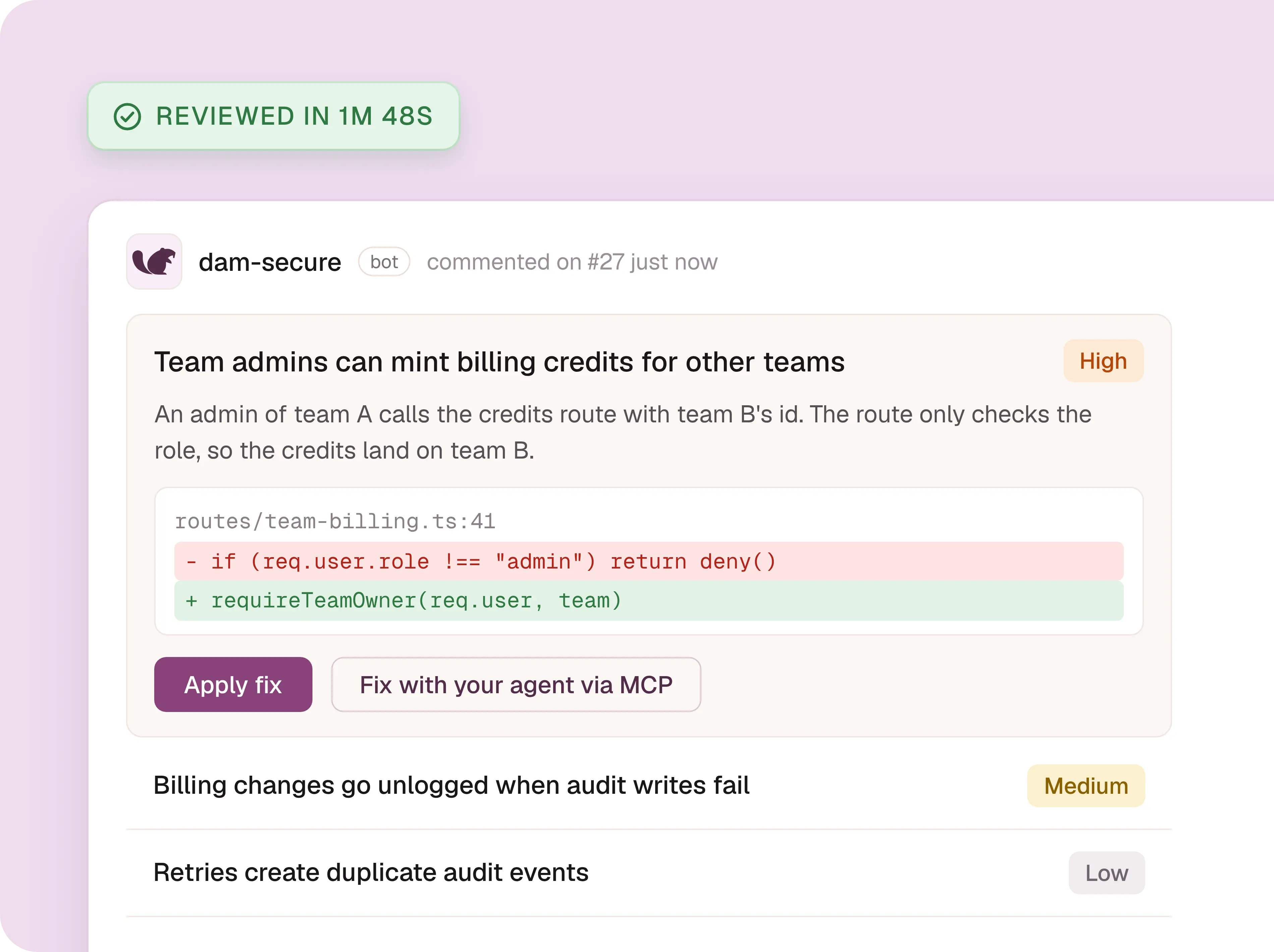
That helps with noise. It doesn't help with the flaws AI-written code is full of, like an endpoint that checks you're signed in but not that you're on the right team, because there's no pattern for a check that isn't there.
And there's a lot more of that code to review. A 2026 study of 302,600 AI-authored commits across 6,299 GitHub repos found AI introduced about 1.5 times as many security issues as it fixed. Georgia Tech's Vibe Security Radar traced 74 CVEs to AI coding tools by the end of March 2026, and its researchers think the real number is five to ten times higher.
An AI-native SAST tool puts the model into detection itself. Below is our take on the ones worth shortlisting in 2026, ours included. We've tried to be fair. We also obviously have a horse in this race.
The shortlist
1. Dam Secure
Best for: mid-size SaaS teams that only want to see what's actually exploitable, and want the same engine on every pull request.
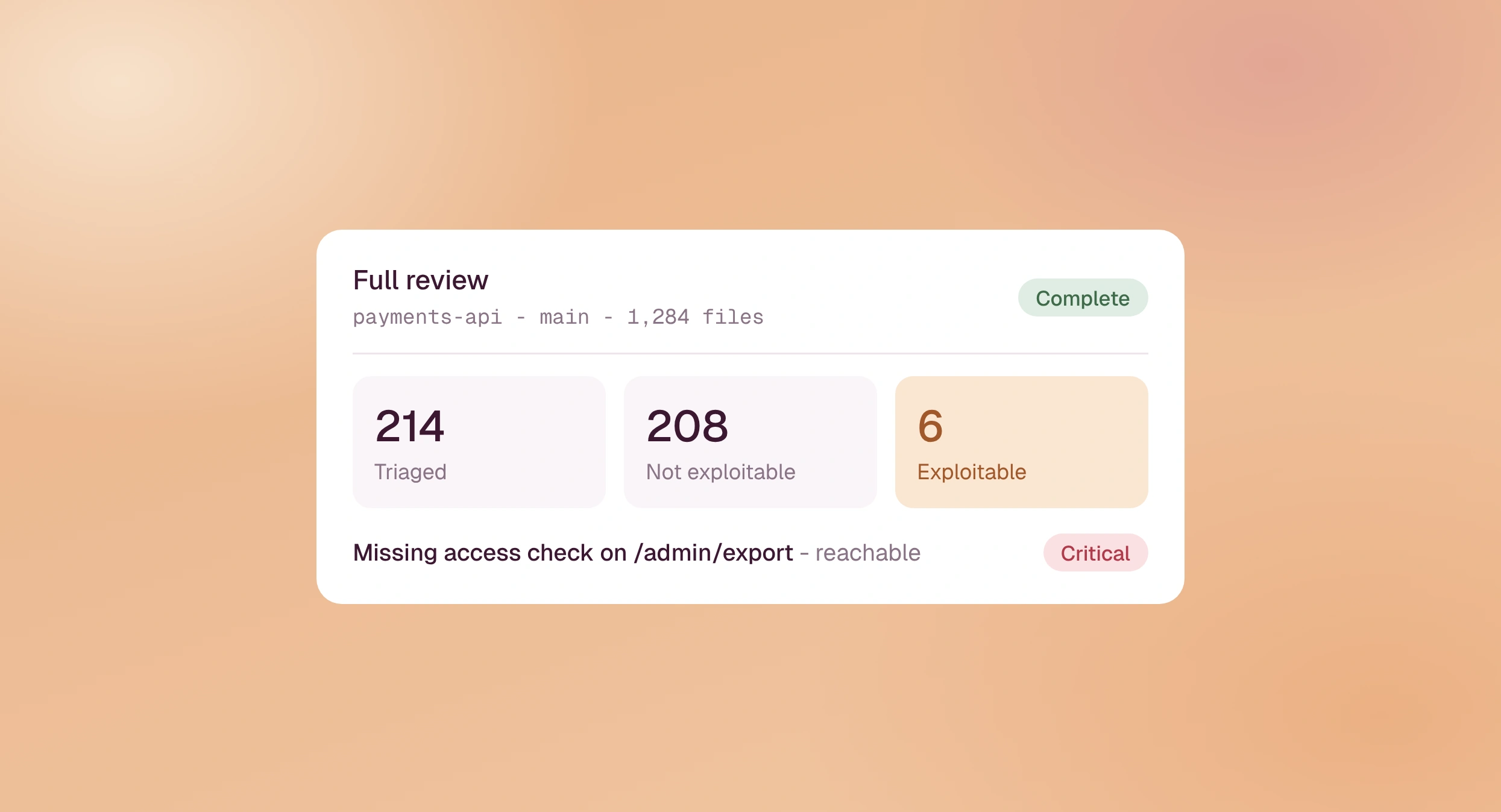
Dam Secure maps how your codebase fits together before it reviews anything: services, data flows, auth, and the routes an attacker could actually reach. Then it reviews your whole default branch and triages each finding the way a security engineer would. Who can reach it? What would it let them do? What already stands in the way? You get a recommended severity with the reasoning spelled out, which beats a CWE number and a shrug.
Teams uncover 40% more exploitable vulnerabilities than their last scanner found, with 3x less noise. Fixes and dismissals carry across every rescan, so nobody re-triages the same SQL injection every quarter. Code findings, exposed secrets and vulnerable dependencies land in one backlog with an audit trail, and developers can pull them into Claude Code or Cursor over MCP and fix them there.
Under the hood, we benchmark frontier models on real findings and route each part of the review to the model that's best at that vulnerability type. Running one frontier model over your whole codebase gets expensive fast. Routing is how a deep review stays affordable.
"Dam Secure has eliminated less effective static analysis tools. We now have a much more sophisticated overview of what we're building." Thor Kappel Davis, CTO, Pluss Communities
2. Corgea
Best for: teams that want AI-generated fixes delivered straight into developer workflows.
Corgea uses AI across detection, triage and remediation, and leans hard on review-ready fixes. It also covers dependencies, secrets, infrastructure as code and containers. Third-party comparisons put pricing at around $34 per developer a month.
Watch for: per-developer pricing adds up as the team grows. Ask what a full review of your codebase costs, too.
3. ZeroPath
Best for: teams that want one tool in place of separate SAST, SCA and secrets products.
ZeroPath traces dataflow from source to sink, then uses AI to confirm each path is actually reachable before it raises a finding. It can also generate and verify fixes in a pull request.
Watch for: test it on business logic, like multi-tenant access checks, as well as the classic injection paths.
4. DryRun Security
Best for: teams that mostly care about catching issues in new changes.
DryRun's Contextual Security Analysis looks at the intent, design and environment of each code change.
Watch for: a change-focused tool won't tell you what's already sitting in your codebase, so check how it handles a full baseline review.
5. Semgrep
Best for: security teams with the time and expertise to write and tune their own rules.
Semgrep covers code, supply chain and secrets. Its Multimodal layer adds AI reasoning on top of rules to cut false positives.
Watch for: detection still starts with rules, so the results are only as good as the rules your team maintains.
6. Snyk Code
Best for: teams already using Snyk for dependencies, containers and infrastructure as code.
Snyk Code runs on DeepCode AI, which combines symbolic analysis with machine learning and suggests fixes.
Watch for: it's strongest on known vulnerability patterns. Flaws specific to how your codebase works need a review that understands it.
How to pick one
Run every tool on your shortlist against the same repo, ideally one where you already know about a few issues. Then look at four things. How many of the known issues did it catch? How many findings did your team have to read to get to them? Does each finding explain why it's exploitable, or just quote a CWE? And what does a full review of your default branch cost, compared with each pull request after that?
One more test worth doing: dismiss a false positive with a reason, rescan, and see if it comes back. You'll learn a lot about how a tool will feel in month six.
It takes about a week, and it'll tell you more than any roundup, including this one.
FAQ
What's the difference between AI-native and AI-powered SAST?
In AI-native SAST, the model takes part in finding vulnerabilities. In AI-powered SAST, a rules engine finds them and AI helps afterwards with triage, summaries or fixes.
Can AI-native SAST replace traditional SAST?
For a lot of teams, yes. Pluss Communities replaced its static analysis tools with Dam Secure. Some teams keep a rules-based tool around for compliance reasons.
Can SAST find business logic vulnerabilities?
Pattern-matching SAST mostly can't, because a missing check doesn't look like anything. An AI-native tool that understands how your codebase is meant to behave can. More in our post on SAST vs DAST vs SCA.
Want to see what your last scanner missed? Speak to our team.