Best AI tools for vulnerability scanning in pull requests (2026)

Summary
The leading AI tools for scanning pull requests for vulnerabilities in 2026 are Dam Secure, Claude Code Review, Codex Security, Corgea, ZeroPath, Semgrep and Snyk Code.
They differ most on cost per PR, how many false positives reach developers, whether findings are checked for exploitability before they're posted, and developer experience.
What is AI vulnerability scanning in pull requests?
It's a security review that runs automatically on each pull request, before the change merges.
The tool reads the diff and the surrounding code, looks for issues like injection, broken access control and leaked secrets, and posts findings as PR comments, ideally with a suggested fix.
Rule-based SAST has done a version of this for years by matching known patterns.
AI-based reviews use language models to reason about what the code does. That lets them catch flaws that have no fixed pattern, such as a missing ownership check on an endpoint.
The trade-off is cost and consistency: model calls cost money on every PR, and two runs can disagree.
Why does PR-level security review matter more now?
Because the volume of PRs has changed. GitHub's Octoverse 2026 report says agents started more than 40% of pull requests in September, up from 17% in March.
Human review hasn't scaled with that. Research from Carnegie Mellon and Stanford found PR volume grew 3.1 times while the reviewer pool grew 1.5 times, and substantive human review dropped from about 39% of PRs to 21%.
If an agent opened the PR and a busy human skimmed it, an automated security review may be the only careful read it gets.
How do the top AI PR security review tools compare?
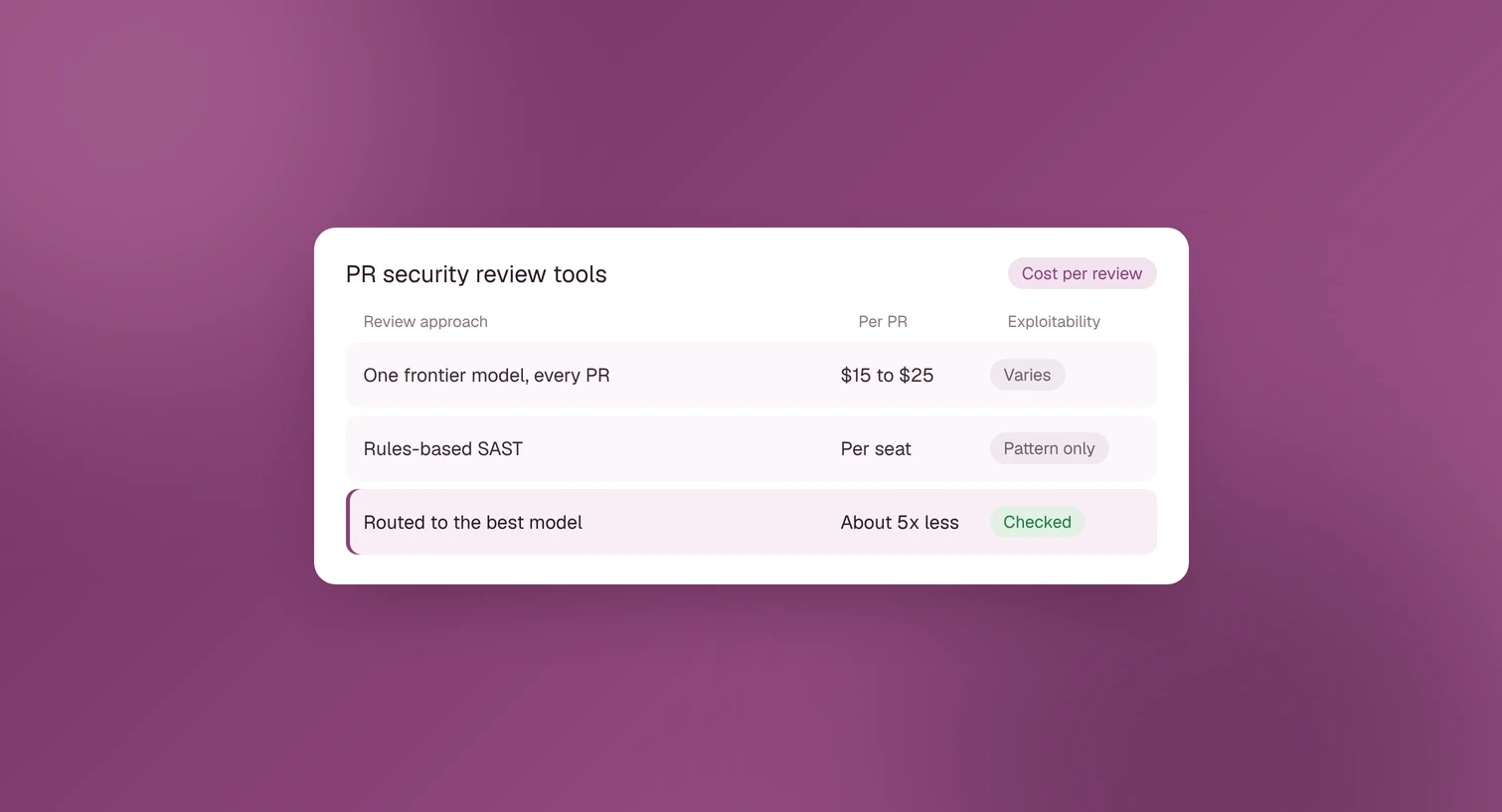
Here's how the main options line up on the things that matter for PR-level review.
Pricing is from each vendor's public pages and docs at the time of writing, so check the latest before you buy.
Dam Secure
Dam Secure is built for teams that want every PR reviewed for security without paying frontier-model prices on each one.
We benchmark frontier models on real security findings every time a new one ships, to learn which model is best at finding each type of vulnerability and what it costs.
Each review is then routed to the best model for that language and vulnerability type, so you get frontier-level results without one expensive model's token bill on every PR.
Reviews finish in under two minutes with fewer than five false positives per PR. AI triage works out who could exploit each finding, which controls already block it and what an attacker would actually gain before anything is posted.
Findings land on the PR with a suggested fix, and developers can fix them there or through their coding agent via MCP. Findings sync to Linear and Slack and close when the fix merges. It works with GitHub, GitLab, Bitbucket and Azure DevOps, and pricing is based on repo size.
Claude Code Review and Claude Security
Anthropic has two relevant products. Claude Code Review is a multi-agent PR review for Team and Enterprise plans. It covers bugs as well as security, and Anthropic says reviews average $15 to $25 each, billed on tokens.
Claude Security, formerly Claude Code Security, focuses on finding vulnerabilities and proposing patches. Its web app is in public beta for Enterprise, with a plugin for other plans.
Both are strong for teams already standardized on Claude. Both run on one vendor's models, and the cost scales directly with PR volume.
Codex Security
Codex Security Review runs a security-focused pass on GitHub PRs, using the diff, repository context and any threat model you configure. You can trigger it on every PR or by commenting @codex security review.
It's a research preview for ChatGPT Enterprise, Business, Edu and Pro. Findings posted on a PR are visible to anyone who can see that PR, which matters for public repositories.
Corgea
Corgea is an AI SAST tool that targets business logic flaws and broken auth, and generates fixes for each finding. PR scanning is included from its Growth plan at $39 per developer per month.
ZeroPath
ZeroPath is an AI-native SAST suite with PR reviews, autofix PRs and an assistant for triage. It advertises PR scans in under a minute.
Its Team plan starts at $1,000 a month plus $60 per developer.
Semgrep
Semgrep is a rules-based engine with an AI layer for auto-triage. It posts PR and merge request comments on every plan, and its Teams plan starts at $30 per contributor per month for code scanning.
Results depend heavily on the rules your team writes and maintains.
Snyk Code
Snyk Code runs static analysis with PR checks across the major source control platforms, alongside Snyk's dependency, container and IaC scanning. It's strongest on known vulnerability patterns.
Snyk's Team plan starts at $25 a month for up to 10 developers, with enterprise pricing on credits.
How much does AI security review cost per PR?
It depends on how the tool charges. Usage-billed tools pass the cost of every review straight to you, and Anthropic says Claude Code Review averages $15 to $25 per review.
Per-seat tools like Corgea and Semgrep charge a flat monthly fee per developer, which is easier to forecast but can come with usage limits.
Teams that moved their PR reviews to Dam Secure were often spending more than $10,000 a month before they switched.
Whichever tool you choose, run the numbers on your real PR volume, including agent-opened PRs, before you commit.
What should you look for in an AI PR security review tool?
- Cost per PR at your volume. Multiply by agent-opened PRs too. A tool that's affordable at 200 PRs a month can be painful at 2,000.
- False positives per PR. Ask for a number, then test it on your own code. Developers stop reading findings once most of them are wrong.
- Exploitability checks. Does the tool assess who could actually exploit a flaw, and what's already in the way, before it posts?
- Memory. When your team dismisses a finding and explains why, does it stay dismissed?
- Speed. A review that takes 10 or 20 minutes holds up merges, especially for agents working in tight loops.
- Developer experience. Findings should land on the PR with a clear explanation and a suggested fix, so developers can act without leaving their workflow. Check it supports your source control platform and issue tracker, and whether developers can fix findings straight from their coding agent.
The fairest test is a trial on your own recent PRs, ideally including a few with known issues.
Run two tools side by side on the same PRs and compare what each finds, what each misses and how much noise each adds.
How Dam Secure fits
Dam Secure gives you frontier-model PR reviews without the frontier-model token bill.
We benchmark models on real security findings and route each review to the one that's best for that language and vulnerability type. That keeps reviews about five times cheaper than Claude Code Security, Codex or a DIY setup.
Teams that switched to Dam Secure were often spending more than $10,000+ a month on PR reviews before.
dam-securebot reviewed in 1m 42s
The Context Engine maps how your codebase fits together, so reviews catch business logic flaws like missing access checks. Every fix and dismissal makes the next review sharper.
Serval's Head of Security, Sam "Frenchie" Stewart, says general AI coding tools "can't learn from their mistakes", and that Dam Secure does both out of the box.
For a head-to-head on one option, see Claude Code Security vs a dedicated PR security review. Want to see Dam Secure on your own PRs? Speak to our team.
FAQ
What is the best AI tool for security review of pull requests?
It depends on volume and budget. For teams that want every PR reviewed at a predictable cost, a dedicated tool like Dam Secure fits best.
Teams already on Claude Enterprise or ChatGPT Enterprise may start with Claude Code Review or Codex Security and watch the bill.
Can AI find vulnerabilities in pull requests that SAST misses?
Yes. AI reviews can reason about intent, so they catch logic flaws like missing authorization checks that have no fixed pattern for rule-based SAST to match.
How much does AI security review cost per PR?
It depends on the tool. Anthropic says Claude Code Review averages $15 to $25 per review, so at 1,000 PRs a month that's roughly $15,000 to $25,000. Per-seat tools charge a monthly fee per developer instead.