Best CodeQL and GitHub Advanced Security alternatives in 2026
Summary
The best CodeQL and GitHub Advanced Security alternatives in 2026 are Dam Secure for low-noise security review on every PR, Semgrep for fast custom rules, Snyk Code for SAST alongside dependency scanning, Corgea and ZeroPath for AI SAST with autofix, and SonarQube for quality and security in one gate.
Most teams look elsewhere because of alert volume, missed logic flaws or per-committer pricing that grows with the team. If your code is open source, or you've built up custom QL queries, staying on CodeQL can make sense.
Why do teams look for CodeQL alternatives?
CodeQL is one of the strongest data-flow engines around, and it's built straight into GitHub. Teams that start looking elsewhere usually hit one of these walls.
1. Alert volume
CodeQL casts a wide net. Its default suite runs 498 security queries covering 170 CWEs, and the extended suite adds more on top. That coverage comes with alerts someone has to triage.
Researchers at CyberArk described CodeQL's output as a flood of results, mostly false positives, at around three minutes to review each alert. Putting an LLM on top of CodeQL cut false positives by up to 96% for some issue types.
2. Logic flaws have no query
CodeQL finds issues by querying how data flows through your code. That's ideal for injection and unsafe deserialization. It's much weaker when the flaw depends on intent, like an endpoint that never checks the caller owns the record. OWASP notes SAST tools find it difficult to automate searches for access control problems.
You can write custom QL queries for your own patterns, but that means someone on your team learning QL and keeping those queries current.
3. Per-committer pricing
GitHub Code Security costs $30 per active committer per month, and Secret Protection adds $19 more. Anyone who pushed to an enabled repository in the last 90 days counts as active.
For 100 active committers, that's $3,000 a month for Code Security, or $4,900 with Secret Protection. GitHub Code Quality, which went generally available in July, adds $10 per active committer, plus usage-based charges for AI features.
4. AI detection is still catching up
In July, GitHub started showing AI security detections on pull requests, covering languages CodeQL doesn't support. It's in public preview, it needs a Copilot license and draws down AI credits, and its findings are informational, so they won't block a merge.
What should you look for in a CodeQL alternative?
Be clear on which wall you hit. A team drowning in alerts needs something very different from a team that's mostly worried about cost.
For noise and logic flaws, AI-native tools are worth a close look. They read the code around each finding, work out whether it's reachable, and drop what isn't before anyone has to look at it.
What are the best CodeQL alternatives in 2026?
Here's how the main options compare.
1. Dam Secure
Best for teams that want every PR reviewed for security without a pile of alerts to work through.
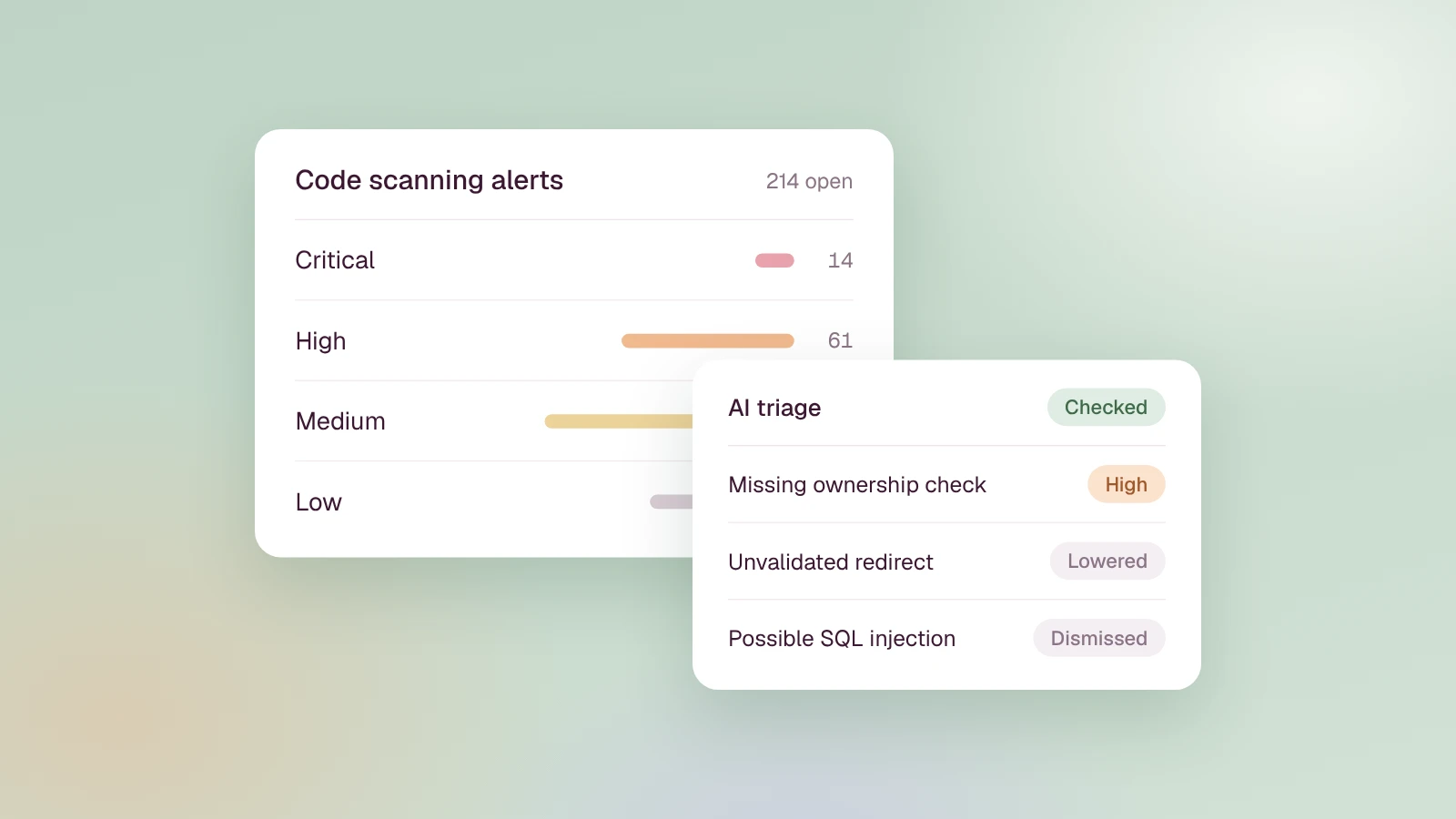
Nine review agents check each PR, with each review routed to the best model for that language and vulnerability type. AI triage then checks every finding against your code before it's posted, and it can lower a severity or dismiss a finding but never raises one. Reviews take under two minutes, with fewer than five findings per PR against the 15 or more common elsewhere.
It costs about a fifth of Claude Code Security or a DIY setup. Pricing is based on repo size, so it stays flat as your team grows. AI-Native SAST covers existing code with full reviews you trigger whenever you need one.
2. Semgrep
Best for security teams that want fast, readable rules. Semgrep rules look like the code they match, which makes them far quicker to write than QL queries. Code scanning starts at $30 per contributor per month. See the best Semgrep alternatives for where it falls short.
3. Snyk Code
Best for teams that want SAST and dependency scanning from one vendor. Snyk's Team plan starts at $25 per contributing developer per month, for teams of up to 10, with credit-based pricing on Enterprise. We cover it in the best Snyk Code alternatives.
4. Corgea
Best for teams that want AI SAST with a fix for every finding. Corgea focuses on business logic and auth flaws, with PR scanning from $39 per developer per month.
5. ZeroPath
Best for teams that want an AI-native SAST suite with one-click autofix. ZeroPath's Team plan starts at $1,000 a month plus $60 per developer.
6. SonarQube
Best for teams that want maintainability and security checks behind one quality gate, and a common pick for teams that don't need GitHub Code Quality on top of Code Security. Security depth varies by edition.
7. Claude Code Review
Best for teams already on a Claude plan who want AI reasoning on each PR. Anthropic says reviews average $15 to $25 each, which adds up quickly at high PR volume.
When should you stay on CodeQL?
CodeQL is a great fit for plenty of teams. Stay if most of these are true:
- Your code is open source, where CodeQL is free.
- You've invested in custom QL queries and someone owns them.
- You're on GitHub Enterprise and Code Security is already budgeted.
- Your developers act on CodeQL alerts and Copilot Autofix suggestions without much pushback.
Plenty of teams also keep CodeQL default setup running and add an AI-native review on top for logic flaws and triage. That works well when both feed one backlog.
How do you test a CodeQL alternative?
Comparison pages, ours included, always rank their own tool first. Your code is the only benchmark that matters, and two weeks is usually enough.
1. Export your CodeQL alert history
Pull the alerts your team dismissed as false positives and the ones it fixed. That gives you a ready-made answer key.
2. Run the alternative on the same repos
Include at least one service with authentication and multi-tenant data, where logic flaws hide.
3. Compare on new PRs
Turn both on for live PRs and track real issues, false positives and misses. Time how long developers spend on each finding.
4. Look at what got filtered
Fewer findings only helps if the real ones survive. Check what each tool auto-dismissed, as well as what it posted.
5. Cost it at your real size
Use your actual active committer count, PR volume and repo sizes, including Actions minutes and any AI credits.
How does Dam Secure fit?
Dam Secure reviews every PR for security and posts only what's worth fixing. Each finding comes with a suggested fix your developers, or their coding agent, can apply.
When you connect a repository, Dam Secure builds a security knowledge graph of your services, data flows and auth patterns. Reviews use it to tell an unprotected endpoint from one that's already checked in middleware.
AI triage then decides what each finding deserves. It keeps a real issue at its severity, lowers one that only an admin could reach, and dismisses one that's already handled. Dismissals your team makes with a reason carry into future reviews, so the same false positive doesn't come back.
As Doug Rathbone at Dovetail puts it: "Dam Secure is the equivalent of a principal security engineer reviewing every change, making sure it's ready for production."
FAQ
Is CodeQL free?
CodeQL code scanning is free for public repositories on GitHub. For private repositories, it's part of GitHub Code Security, which costs $30 per active committer per month.
What counts as an active committer for GitHub Code Security?
Anyone who pushed a commit to a repository with Code Security enabled in the last 90 days. Each person counts once across your organization.
Does GitHub Code Security use AI to find vulnerabilities?
CodeQL itself is query-based. GitHub's AI security detections on pull requests are in public preview, need a Copilot license, and post informational findings that don't block merges.
Can I run Dam Secure alongside CodeQL?
Yes. Many teams keep CodeQL default setup and add Dam Secure for PR security reviews, so logic flaws get caught and findings are triaged before developers see them.
Want to compare on your own PRs? Speak to our team.