Best Snyk Code alternatives in 2026 (and when to stay)
Summary
The best Snyk Code alternatives in 2026 are Dam Secure for low-noise security review on every PR, Corgea and ZeroPath for AI SAST with autofix, Semgrep for custom rules, GitHub Code Security for teams on GitHub, and SonarQube for quality and security in one gate.
Most teams look elsewhere because of false positives, missed access control flaws or costs that climb with every contributor. If you rely on Snyk for dependencies, containers and IaC, keeping it for those and replacing only Snyk Code can make sense.
Why do teams look for Snyk Code alternatives?
Snyk Code is a capable SAST tool, and plenty of teams run it happily. The ones who start looking usually have one of these reasons.
1. Noise
False positives are the most common complaint. On G2, reviewers score Snyk 6.7 out of 10 for false positives in SAST, and one reviewer noted that Snyk Code results feel less mature than its dependency scanning, with less context on why something was flagged.
Every finding a developer has to check and dismiss costs time. Once that happens often enough, they stop reading the findings at all.
2. Patterns can't see intent
Snyk Code finds issues using a symbolic rule engine curated by Snyk's researchers, plus machine learning trained on public open-source code. That works well for known vulnerability patterns like injection and unsafe crypto.
It struggles with flaws that depend on what your code is meant to do. OWASP notes that SAST tools find it difficult to automate searches for authentication and access control problems, which is exactly where AI-written code tends to go wrong.
3. Cost as the team grows
The Free plan includes 100 Snyk Code tests a month across 5 projects. Team starts at $25 per contributing developer per month, for teams of 5 to 10 developers. Past that, Enterprise bills Snyk Code at one credit, worth $1, per active contributor per day.
Usage-based pricing is fair, but it gets harder to forecast as more of your code comes from agents and more people push to more repos.
4. Platform changes
Snyk is reshaping its product line. The Snyk Code Local Engine is deprecated, and Snyk isn't taking on new Local Engine deployments. Snyk Code Quality was retired in August 2026.
In October, Snyk launched Evo Agentic AppSec, a set of AI agents that run Snyk Code and its other engines as tools. The code scanning and security review agents are in experimental preview for select customers, so most teams are still on the engine itself today.
What should you look for in a Snyk Code alternative?
Start with the reason you're leaving. The right replacement for a noise problem looks very different from the right replacement for a pricing problem.
If noise is the main reason, look closely at AI-native tools. They use models to read the code around each finding and work out whether it's reachable and exploitable before anyone sees it.
That step makes a real difference. In a 2026 industry study at Tencent, engineers spent 10 to 20 minutes checking each static analysis alarm by hand, and combining LLMs with static analysis removed 94 to 98% of false positives.
What are the best Snyk Code alternatives in 2026?
Here are the main options, with what each one suits best.
1. Dam Secure
Best for teams that want a security review on every PR that developers actually read.
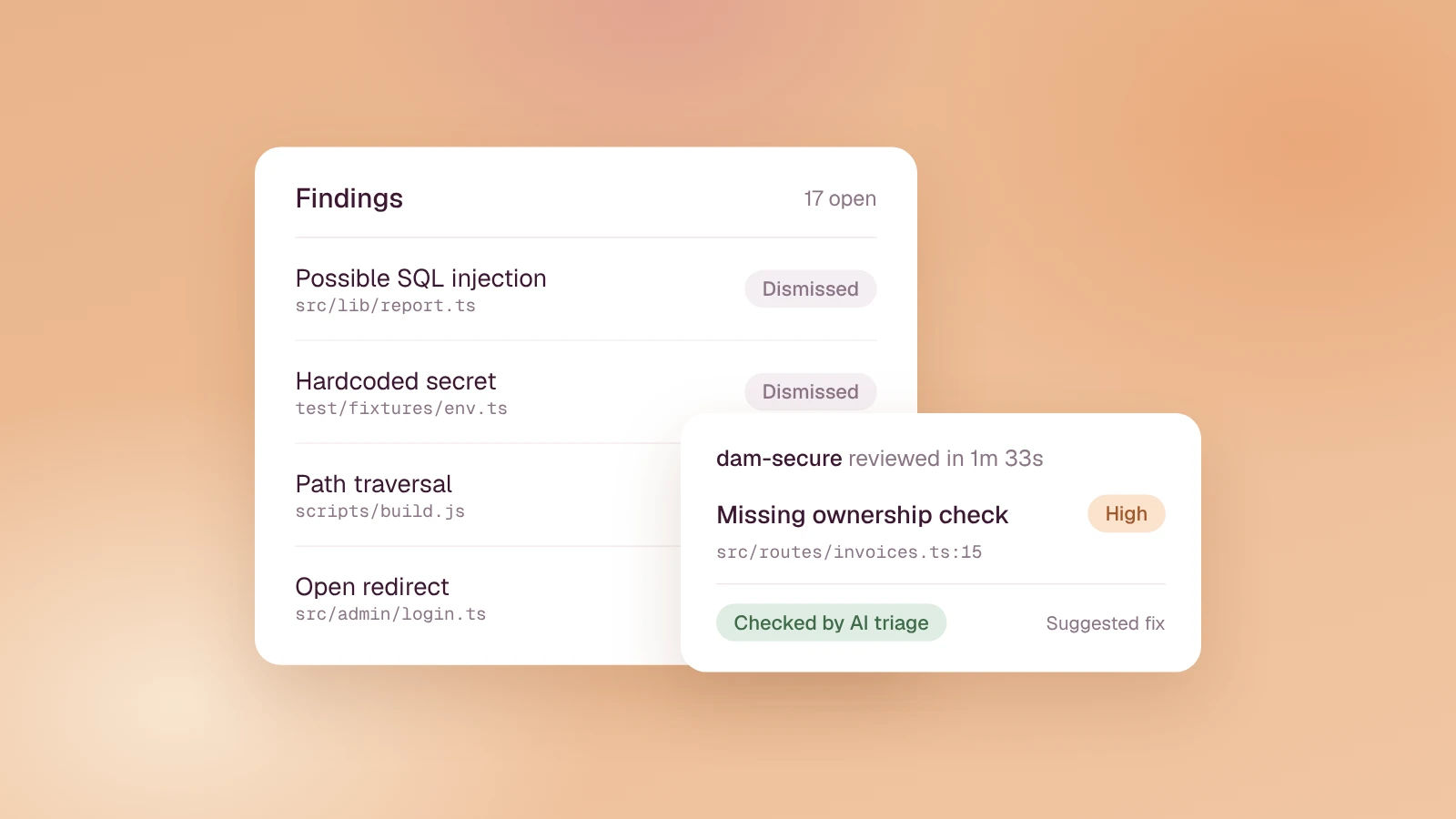
Nine review agents check each PR, and each review goes to the best model for that language and vulnerability type. AI triage then checks every finding against your code before it's posted. Reviews take under two minutes and post fewer than five findings per PR, against the 15 or more common with other tools.
It costs about a fifth of Claude Code Security or a DIY setup, and pricing is based on repo size, so it doesn't climb with every new contributor. AI-Native SAST runs full reviews of existing code whenever you trigger one.
2. Corgea
Best for teams that want AI SAST with a fix generated for every finding. Corgea focuses on business logic and auth flaws, with PR scanning included from $39 per developer per month.
3. ZeroPath
Best for teams that want an AI-native SAST suite with PR scans and one-click autofix. ZeroPath's Team plan starts at $1,000 a month plus $60 per developer.
4. Semgrep
Best for security teams that want control over exactly what gets flagged. Semgrep's rules give the same result on the same code every time. Code scanning starts at $30 per contributor per month, and someone has to write and maintain the rules. We cover it in more depth in the best Semgrep alternatives.
5. GitHub Code Security (CodeQL)
Best for teams whose code all lives on GitHub. CodeQL is strong at data-flow analysis and free for public repositories. For private ones, GitHub Code Security launched at $30 per active committer per month. Custom queries mean learning the QL language.
6. SonarQube
Best for teams that want code quality and security checks behind one quality gate. It's a natural home for teams who used Snyk Code Quality before it was retired. Security depth varies by edition, so check which checks need a paid tier.
7. Claude Code Review
Best for teams already on a Claude plan who want AI reasoning on their PRs. Anthropic says reviews average $15 to $25 each, so it adds up fast at high PR volume. We compare it in the best alternatives to Claude Code Security.
When should you stay on Snyk Code?
Switching has a cost, and Snyk Code is the right fit for a lot of teams. Stay if most of these are true:
- You use Snyk for dependencies, containers and IaC, and one vendor matters more to you than SAST accuracy.
- Real-time feedback in the dev environment is your top priority.
- You're mid-contract on Enterprise and the spend is already budgeted.
- Your developers are fixing findings, and noise isn't slowing them down.
You don't have to move everything at once, either. Plenty of teams keep Snyk Open Source for dependencies and add an AI-native review for code. That works well, as long as findings end up in one backlog.
How do you compare Snyk Code alternatives fairly?
Every vendor's comparison page, ours included, puts its own tool first. What counts is how each tool does on your code. A two-week trial is usually enough.
1. Use your own repos
Pick two or three, including one with authentication and multi-tenant logic. That's where pattern-based tools and AI-native tools differ most.
2. Seed it with issues you already know about
Past security fixes, pentest findings and advisories from your own code make a far better test than a generic benchmark.
3. Run Snyk Code on the same PRs
Compare findings side by side. Count real issues, false positives and misses, and time how long a developer takes to confirm or dismiss each one.
4. Check what each tool hid
Aggressive filtering can suppress real findings too. Look at what each tool auto-dismissed, as well as what it showed.
5. Price it at your real size
Use your actual contributor count, PR volume and repo sizes, including any AI credits or token costs.
How does Dam Secure fit?
 dam-securebotreviewed in 1m 33s
Dam Secure reviews every PR for security and posts only the findings that matter, each with a suggested fix your developers or coding agent can apply.
When you connect a repository, Dam Secure builds a security knowledge graph of your services, data flows and auth patterns. Reviews use it to tell an endpoint that's missing an ownership check from one that's already protected two files away.
Every finding then goes through AI triage, which keeps the severity, lowers it or dismisses the finding. When your team dismisses something with a reason, that reason carries into future reviews, so the same false positive doesn't come back.
As Doug Rathbone at Dovetail puts it: "Dam Secure is the equivalent of a principal security engineer reviewing every change, making sure it's ready for production."
FAQ
Is Snyk Code free?
Snyk's Free plan includes 100 Snyk Code tests a month across 5 projects. The Team plan starts at $25 per contributing developer per month for teams of up to 10, and Enterprise uses credit-based pricing.
What is Snyk Code built on?
Snyk Code runs on DeepCode AI, which combines a symbolic rule engine curated by Snyk's researchers with machine learning models trained on public open-source code.
Can I keep Snyk Open Source and replace Snyk Code?
Yes. Many teams keep Snyk for dependency scanning and add an AI-native tool for code review. Route findings from both into one backlog so nothing gets missed.
What's the best Snyk Code alternative for reducing false positives?
AI-native tools such as Dam Secure, Corgea and ZeroPath check whether each finding is reachable and exploitable before showing it. Test them on your own repos to see which suits your code.
Want to compare on your own PRs? Speak to our team.