Best Checkmarx alternatives in 2026

Summary
The best Checkmarx alternatives in 2026 are Dam Secure for low-noise security review on every PR, Semgrep for fast custom rules, Snyk Code for SAST alongside dependency scanning, GitHub Code Security for teams on GitHub, Corgea and ZeroPath for AI SAST with autofix, and SonarQube for quality and security in one gate.
Teams usually look elsewhere because of false positives, slow scans or quote-based pricing. If you need one vendor for SAST, SCA, IaC and API security, or a self-hosted deployment, Checkmarx can still be the right fit.
Why do teams look for Checkmarx alternatives?
Checkmarx One is one of the broadest AppSec platforms on the market, covering SAST, SCA, IaC, API security and containers. Teams that move away from it tend to give the same few reasons.
1. False positives
On G2, reviewers score Checkmarx 6.3 out of 10 for false positives, against 7.3 for Semgrep. A common theme in reviews is a high number of false positives unless the tool is tuned for each project. One reviewer on AWS Marketplace estimated that more than 80% of the issues they saw were false positives.
Tuning works, but someone has to own it for every project. Teams without a dedicated AppSec engineer often can't keep up.
2. Scan time
Full SAST scans on large codebases take time, and reviewers regularly mention slow scans compared with other tools. When results arrive after a developer has moved on, fixes slip.
3. Pricing you can't see up front
Checkmarx doesn't publish list prices. Its pricing page says Checkmarx One is priced per package and tailored to your environment. The clearest public numbers are on AWS Marketplace, where Checkmarx One Essential lists at $1,564 per license per year. For 100 developers, that's about $156,400 a year before add-ons.
4. Logic flaws
Like any pattern-based SAST, Checkmarx is strongest on known vulnerability types. OWASP notes SAST tools find it difficult to automate searches for authentication and access control problems, which is where AI-written code tends to go wrong.
What should you look for in a Checkmarx alternative?
Start with why you're leaving. Teams leaving over noise and teams leaving over price often end up with different tools.
If noise is the main reason, look at AI-native tools. They read the code around each finding and check whether it's reachable before anyone sees it, so developers aren't the ones doing the triage.
What are the best Checkmarx alternatives in 2026?
Here's how the main options compare.
1. Dam Secure
Best for teams that want every PR reviewed for security without a dedicated person tuning the tool.
Nine review agents check each PR, each routed to the best model for that language and vulnerability type. AI triage then checks every finding against your code before it's posted. Reviews take under two minutes, with fewer than five findings per PR against the 15 or more common with other tools.
It costs about a fifth of Claude Code Security or a DIY setup, and pricing is based on repo size. AI-Native SAST covers existing code with full reviews whenever you trigger one.
2. Semgrep
Best for security teams that want fast scans and rules that read like the code they match. Code scanning starts at $30 per contributor per month. See the best Semgrep alternatives.
3. Snyk Code
Best for teams that want SAST and dependency scanning from one vendor with self-serve pricing. The Team plan starts at $25 per contributing developer per month. See the best Snyk Code alternatives.
4. GitHub Code Security
Best for teams whose code all lives on GitHub. CodeQL is built in, and Code Security costs $30 per active committer per month. See the best CodeQL alternatives.
5. Corgea
Best for teams that want AI SAST with a fix for every finding. Corgea focuses on business logic and auth flaws, from $39 per developer per month.
6. ZeroPath
Best for teams that want an AI-native SAST suite with one-click autofix. ZeroPath's Team plan starts at $1,000 a month plus $60 per developer.
7. SonarQube
Best for teams that want maintainability and security checks behind one quality gate. Security depth varies by edition.
When should you stay on Checkmarx?
Checkmarx has changed a lot recently. In June it launched a hybrid SAST engine that it says cuts false positives by 60%, and its Fusion hybrid scanning is in early access. If you last evaluated it a few years ago, it's worth a fresh look.
Stay if most of these are true:
- You need SAST, SCA, IaC, API and container security from one vendor.
- You need a self-hosted deployment.
- You have AppSec engineers who own tuning and triage.
- You're mid-contract and the spend is budgeted.
Plenty of teams also keep Checkmarx for full scans and add an AI-native PR review on top, so developers only see findings that matter on the code they're changing.
How do you compare Checkmarx alternatives?
Every comparison page, ours included, ranks its own tool first. Two weeks on your own code tells you far more.
1. Export your triage history
Pull the Checkmarx results your team marked not exploitable, and the ones it fixed. That's your answer key.
2. Run the alternative on the same repos
Include one service with authentication and multi-tenant data, where logic flaws hide.
3. Compare on live PRs
Track real issues, false positives and misses, and how long developers spend on each finding.
4. Check what got filtered out
Fewer findings only help if the real ones survive. Look at what each tool dismissed, as well as what it showed.
5. Price it at your real size
Get a written quote for your actual developer count and modules, and compare it with published pricing elsewhere.
How does Dam Secure fit?
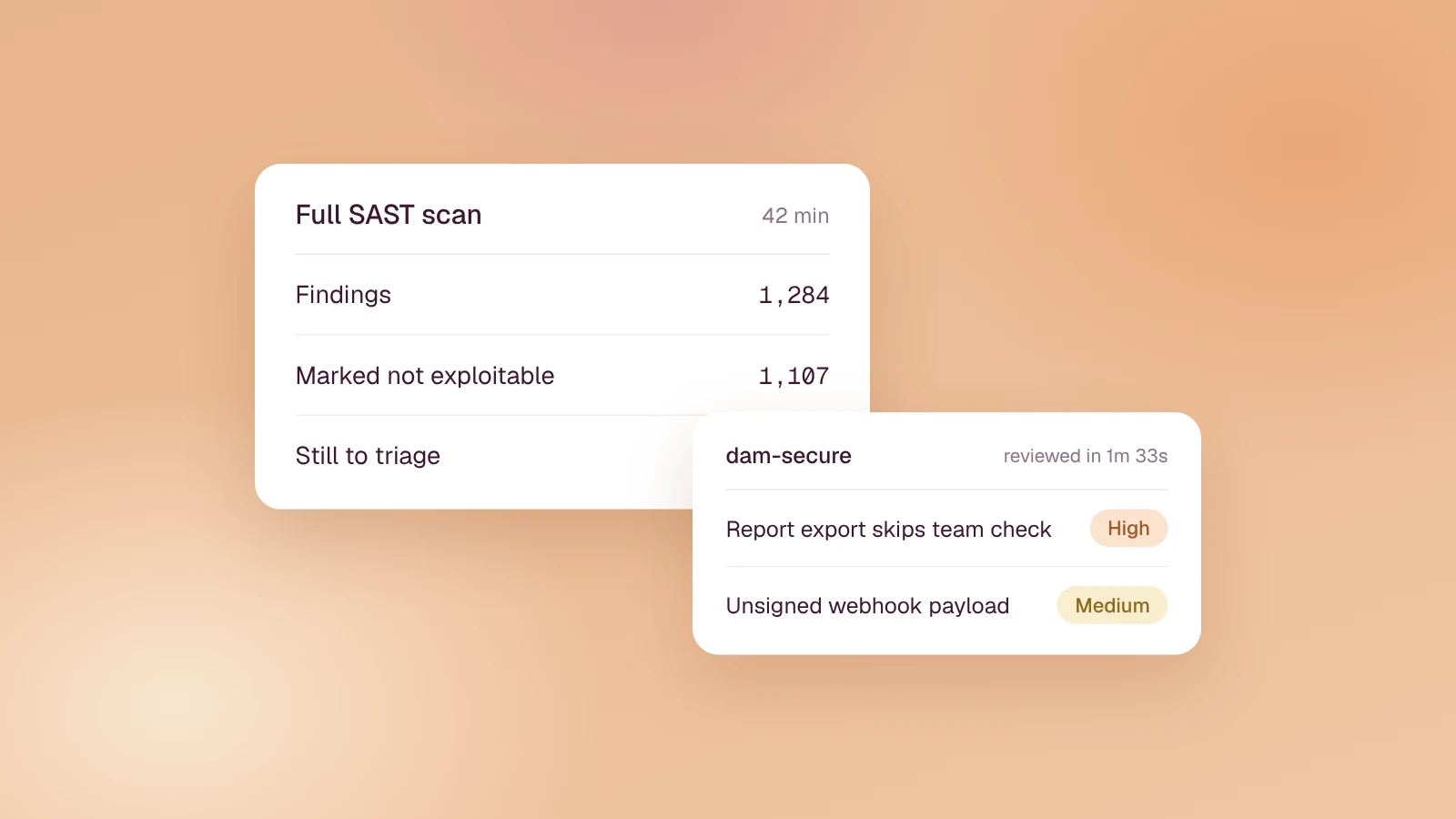
 dam-securebotreviewed in 1m 33s
Dam Secure reviews every PR for security and posts only the findings worth fixing, each with a suggested fix your developers or their coding agent can apply.
When you connect a repository, Dam Secure builds a security knowledge graph of your services, data flows and auth patterns. That's how a review spots an export endpoint that skips the team check every other endpoint uses, with no per-project tuning.
AI triage then keeps, lowers or dismisses each finding. When your team dismisses something with a reason, that reason carries into future reviews, so the same false positive doesn't come back.
As Doug Rathbone at Dovetail puts it: "Dam Secure is the equivalent of a principal security engineer reviewing every change, making sure it's ready for production."
FAQ
How much does Checkmarx cost?
Checkmarx doesn't publish list prices, and quotes depend on modules and developer count. On AWS Marketplace, Checkmarx One Essential lists at $1,564 per license per year.
Why does Checkmarx produce so many false positives?
Like most pattern-based SAST, it flags any code that matches a risky pattern, whether or not it's reachable. Reviewers say accuracy improves a lot once presets are tuned for each project.
Is there a Checkmarx alternative that doesn't need tuning?
AI-native tools such as Dam Secure, Corgea and ZeroPath check whether each finding is reachable and exploitable before showing it, so they need far less per-project tuning.
Can I use Dam Secure alongside Checkmarx?
Yes. Many teams keep their existing scanner for full scans and add Dam Secure for PR security reviews, so developers see a handful of real findings on each change.
Want to see it on your own PRs? Speak to our team.