Code security tools compared: what each type catches in AI-generated code

Summary
Code security tools fall into five types, and each catches a different set of issues in AI-generated code. Rules-based SAST catches known patterns like injection, dependency security catches vulnerable and made-up packages, and AI code reviewers mostly comment on quality.
Security built into coding agents and AI-native SAST both reason about intent, which is where AI-written code tends to go wrong. For most mid-market teams, two layers cover it: dependency security, plus a security review on every PR that understands the rest of the codebase.
Why does AI-generated code change which security tool you need?
Coding agents are great at writing code that compiles and passes tests. They're much less reliable at the parts of security that depend on how the rest of your system works.
A Cloud Security Alliance research note from April 2026 found that between 45% and 70% of AI-generated code samples fail security tests, depending on how they're tested. Authorization flaws, missing access controls and hardcoded credentials were the most common failures.
That matches the OWASP Top 10 for 2025, where broken access control is still the number one risk. OWASP also notes that authentication and access control problems are difficult for SAST tools to search for automatically.
So when you compare code security tools for AI-generated code, start with which issues each tool can see at all. Feature lists can wait.
What are the main types of code security tools?
Most tools on the market fit one of five types. Some vendors sell more than one, but each type works differently under the hood.
Those differences matter most for flaws that depend on intent. Picture an endpoint that checks you're logged in but never checks the record belongs to you. Some of these tools will flag it, and some can't see it at all.
What does each type of tool catch in AI-generated code?
1. Rules-based SAST
Rules-based SAST tools like Semgrep, CodeQL and SonarQube match code against patterns for known vulnerability types. They're fast and predictable, and they give the same result on the same code every time.
They do well on injection, unsafe functions and weak crypto. They struggle with anything that depends on what the code is meant to do.
A January 2026 study from Peking University found that CodeQL and Semgrep detected about 10% of the known Java vulnerabilities in its benchmark. On real open-source projects, CodeQL averaged an 85% false discovery rate.
If you're weighing a move off one of these, we compare the options in the best Semgrep alternatives and the best CodeQL alternatives.
2. Dependency security
Dependency security tools, also called SCA, check the open-source packages you install against vulnerability advisories. Dependabot, Snyk Open Source and Socket are common examples.
They matter more with coding agents in the loop, because models sometimes suggest packages that don't exist. A USENIX Security 2025 study found that 5.2% of packages suggested by commercial models and 21.7% from open-source models were hallucinated. Attackers can register those names and wait for someone to install them.
Dependency security only looks at packages, though. A missing permission check in code your team wrote is outside what it checks. We cover how to buy one in how to choose dependency security software for AI-written code.
3. AI code reviewers
AI code reviewers like GitHub Copilot code review and Cursor Bugbot read each PR and leave comments. They're good at catching convention drift, missing error handling and obvious mistakes.
Security is usually a side job for them. When researchers at Toronto Metropolitan University tested Copilot's code review on labeled vulnerable code, it frequently missed SQL injection, cross-site scripting and insecure deserialization. Most of its feedback was about style and typos.
Keep one for code quality if your team likes it. Just count something else as your security review.
4. Security built into coding agents
Anthropic's Claude Security (formerly Claude Code Security) and Claude Code Review use frontier models to reason about your code the way a security researcher would. They can find flaws that span several files and depend on intent.
The trade-offs are access and cost. Claude Security is in public beta for Claude Enterprise customers, with repository scans you run on demand or on a schedule. Claude Code Review averages $15 to $25 per review, which adds up fast when agents open dozens of PRs a day.
You're also tied to one vendor's models, even when another model is better at a given type of vulnerability that month. We compare the options in the best alternatives to Claude Code Security.
5. AI-native SAST
AI-native SAST tools, including Dam Secure, Corgea and ZeroPath, use models to read the code around each potential issue. They check whether it's reachable and exploitable before anyone sees it.
That's how they catch access control and logic flaws without burying developers in noise. The same Peking University study found that LLM-based detectors uncover more unique vulnerabilities than traditional tools, but the research tools it tested also had very high false discovery rates.
In other words, how a tool filters its own findings matters as much as how it finds them. Tools in this group vary a lot, so test them on your own repos.
How do the five types compare side by side?
Here's how each type typically handles the issues that show up most in AI-generated code. Treat it as a starting point, since individual tools vary.
Which code security tools does a mid-market SaaS team need?
You don't need one of everything. For most teams with 50 or more developers, two layers cover the risks that matter.
- Dependency security, so vulnerable and made-up packages get caught before they ship.
- A security review on every PR that understands the rest of your codebase, so access control and logic flaws get caught while the change is still small.
Keep rules-based SAST if your security team has invested in custom rules, and keep your AI code reviewer for quality. Send findings from every tool into one backlog, so nothing slips between them.
Watch the noise as closely as the coverage. A developer who gets 15 comments on a two-file PR stops reading them.
How do you test code security tools on AI-generated code?
Vendor comparisons, ours included, put their own tool first. A two-week trial on your own code tells you far more.
1. Use PRs your agents actually wrote
Pick recent agent-written PRs from two or three repos. Include one with authentication and multi-tenant logic, since that's where the tool types differ most.
2. Seed issues you already know about
Past security fixes, pentest findings and advisories from your own code make a better test than a generic benchmark.
3. Run the tools side by side
Count real issues, false positives and misses for each tool. Time how long a developer takes to confirm or dismiss each finding.
4. Price it at your real PR volume
Use your actual PR count, contributor count and repo sizes, including any per-review or token costs. For a full scorecard, see how to compare PR security review tools.
How does Dam Secure fit?
 Openclaude-code wants to merge 1 commit into main from feat/report-export
 dam-securebotreviewed in 1m 41s
Dam Secure reviews every PR for security and posts only the findings that matter, each with a fix your developers or coding agent can apply.
Nine proprietary review agents check each PR. Dam Secure benchmarks models to learn which ones are best at finding which vulnerabilities, then routes each review to the model that performs best for that language, use case and vulnerability type.
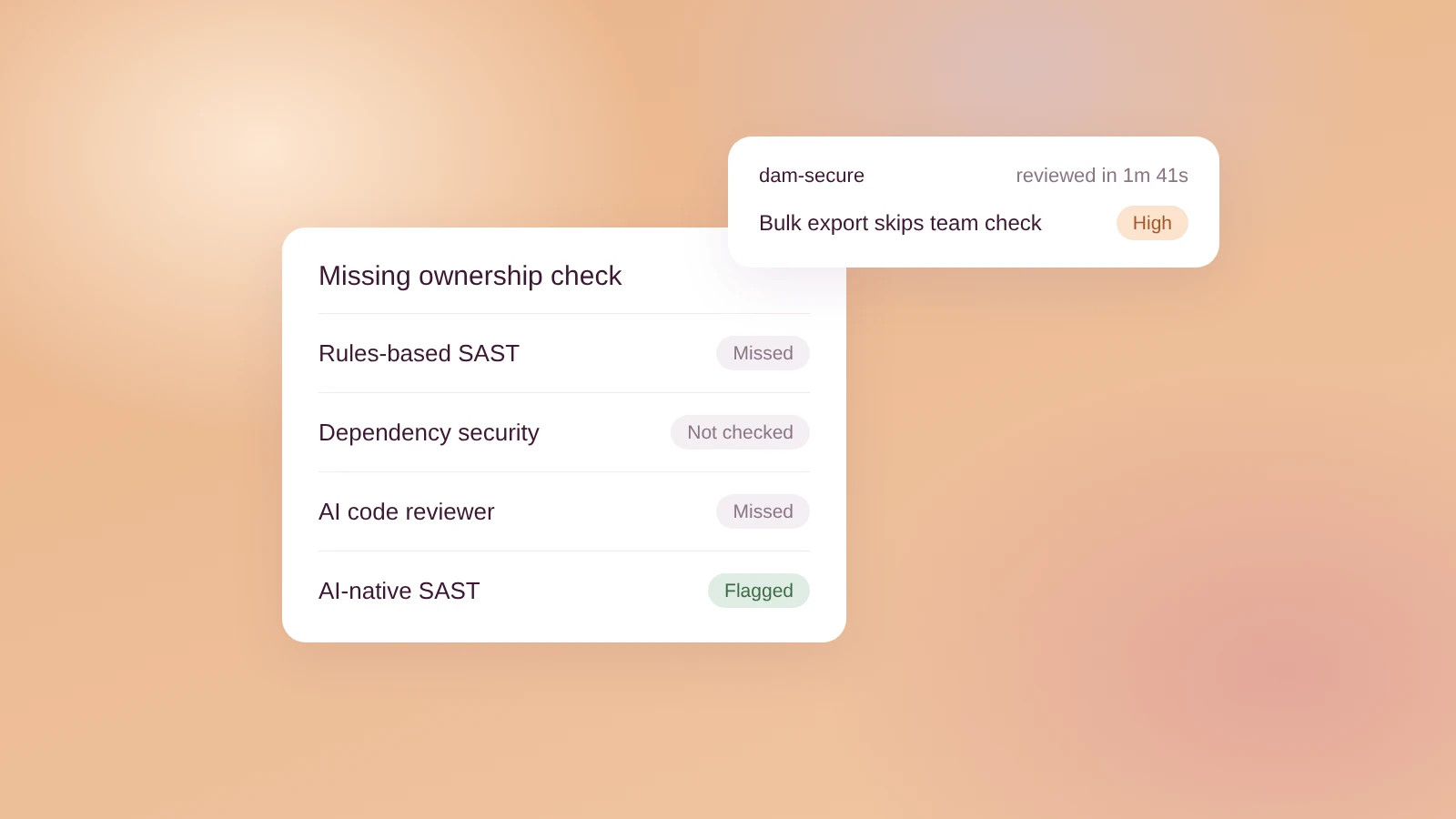
Reviews draw on a Secure Knowledge Graph of your codebase, so Dam Secure can tell an endpoint that's missing an ownership check from one that's protected two files away. AI triage then checks every finding against your code before it's posted.
Reviews come back in under two minutes with fewer than five findings per PR, against the 15 or more common with other tools. It costs about a fifth of Claude Code Security or a DIY setup, and pricing is based on repo size rather than tokens.
AI-Native SAST runs full reviews of your existing code whenever you trigger one, and Dependency Security covers the packages your code pulls in.
Dovetail switched to Dam Secure from Claude Code Security. As Sebastian Vaughan, Platform Engineering Manager at Dovetail, puts it: "This is far better than what we were getting from Claude Code Security."
FAQ
What's the difference between SAST and AI-native SAST?
Rules-based SAST matches code against patterns for known vulnerability types. AI-native SAST uses models to read the code around each potential issue and check whether it's exploitable, which helps with access control and logic flaws. We break down the wider landscape in SAST vs DAST vs SCA.
Do I still need dependency security if I use AI-native SAST?
Usually, yes. Code review and dependency checks look at different things. Some platforms, Dam Secure included, cover both, so check what's included before buying two tools.
Can an AI code reviewer replace a security tool?
On its own, rarely. General AI code reviewers focus on quality, and independent testing has found they miss common vulnerabilities like SQL injection. Pair one with a dedicated security review.
Which code security tools catch IDOR vulnerabilities?
Tools that understand who owns which data in your codebase, which usually means AI-native SAST or security built into coding agents. Pattern-based tools rarely catch them. More in why scanners miss IDOR vulnerabilities.
Is Claude Security enough on its own?
It finds real issues, and it's a strong option for teams on Claude Enterprise. The questions to ask are cost at your PR volume, whether it covers every PR, and whether you're comfortable relying on one vendor's models.
Want to see what each type of tool catches on your own PRs? Speak to our team.